
News Desk · Everything Space
Vega C rocket delivers FLEX and Sentinel-3C satellites to orbit from French Guiana
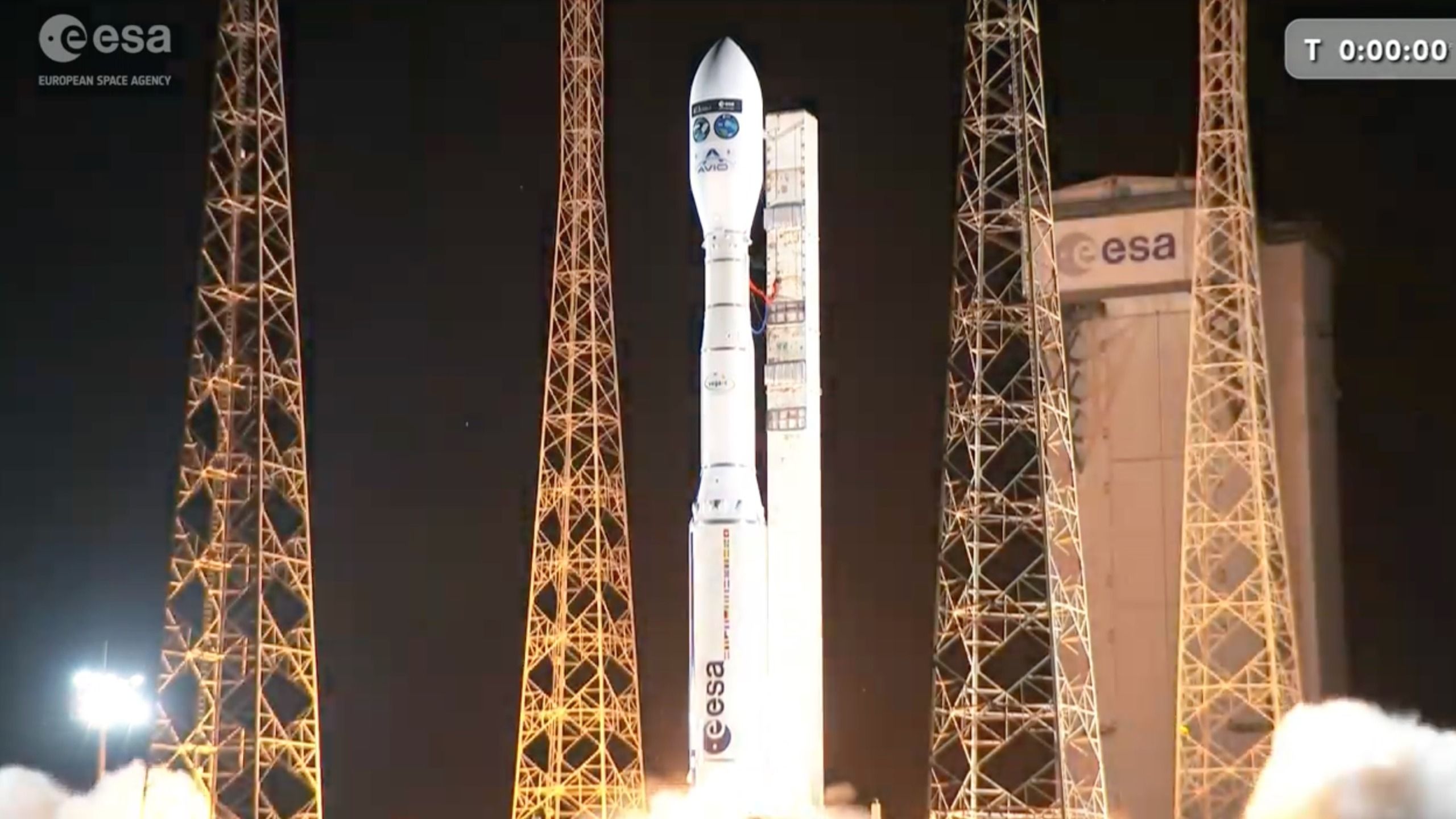
Image: Space.com
The launch adds a new tool for tracking plant photosynthesis and extends a key European ocean and climate monitoring program.
A Vega C rocket lifted off from Europe's spaceport in Kourou, French Guiana, carrying two Earth-observing satellites, FLEX and Sentinel-3C, into orbit late Sunday night local time.
Both spacecraft are set to be released at an altitude of roughly 509 miles, with full separation from the rocket expected within about two hours of liftoff, assuming the mission proceeds as planned.
FLEX, short for Fluorescence Explorer, is designed to detect a faint glow given off by plants during photosynthesis, a capability no current satellite has. This data is expected to help scientists better understand the global carbon cycle and assist in agricultural monitoring and food security efforts as demand for crop production grows.
Sentinel-3C joins the European Union's Copernicus Earth-observation program, extending a satellite line that already includes two active predecessors launched in 2016 and 2018. Like its siblings, it carries instruments meant to track oceans, land, ice, and atmosphere, feeding near-real-time data into ocean and weather forecasting systems.
The Vega C rocket, which debuted in 2022, has now flown eight missions, with seven of its prior flights succeeding. The vehicle was originally operated by Arianespace but is now managed by Avio, the Italian company overseeing its launches, marking Avio's second time running a Vega C flight.
Sources
Vega C rocket launches 2 European Earth-observing satellites launching to orbit from South America
Written in Everything Space’s own words by our news-desk model from the sources above, and checked against them in code: every number in this report appears in its sources, and no sentence is copied from them.