
News Desk · Everything Space
Study finds Earth and Mars formed through different planet-building processes
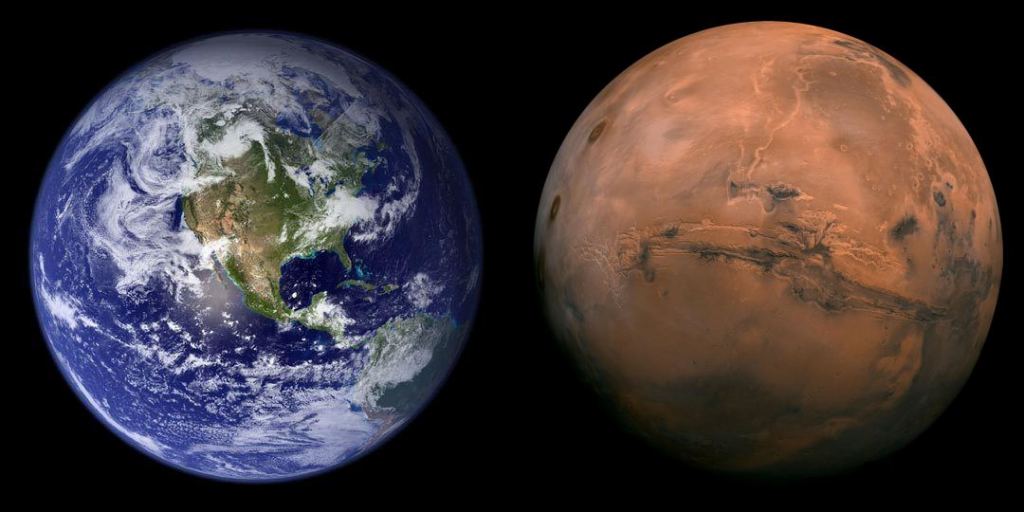
Image: Universe Today
Chemical analysis suggests Earth grew mainly by accreting pebbles while Mars formed largely from colliding planetesimals, reshaping ideas about rocky planet formation.
Researchers at the University of Copenhagen have found evidence that Earth and Mars, despite forming in the same solar system, took different paths to becoming planets. The findings, published in Nature Astronomy, could help resolve a long-standing debate over whether rocky planets form mainly through collisions of large rocky bodies called planetesimals or through the gradual buildup of smaller particles known as pebbles.
The team, led by Haiyang S. Wang and Anders Johansen along with collaborators from several institutions, examined the abundance of volatile elements such as sodium, zinc, and potassium in the crust and mantle of Earth and Mars. These elements evaporate easily under heat, so their presence or absence serves as a kind of fingerprint for the conditions a planet experienced while it was forming.
Using statistical modeling based on this chemical data, the researchers concluded that Earth formed primarily when two early protoplanets grew by steadily accumulating pebbles, with collisions between planetesimals contributing a smaller share of its mass. Mars, by contrast, appears to have formed mostly from planetesimal collisions, with pebble accretion playing a lesser role. According to the estimates, roughly three-quarters of Earth's mass came from pebble accretion, while about three-quarters of Mars's mass came from planetesimal collisions.
Wang noted that this was an unexpected result, since two planets forming in proximity within the same solar system might be assumed to share similar formation histories. The team stressed that their conclusions rest on statistical modeling involving some assumptions, including estimates of the original chemical makeup of the solar system's planet-forming disk and the composition of planetesimal material. Even accounting for these uncertainties, the researchers say the core finding — that Earth and Mars formed differently — remained consistent.
The scientists argue their approach offers a clearer method for studying planet formation than techniques relying on isotope analysis, which can be open to multiple interpretations. They also suggest the findings could aid efforts to evaluate the habitability of planets beyond our solar system, since understanding how planets lose or retain volatile elements during formation may help predict how much water and similar life-supporting materials a planet ends up with. Future observatories designed to analyze the chemical makeup of distant worlds could build on this type of formation modeling.
Sources
Written in Everything Space’s own words by our news-desk model from the sources above, and checked against them in code: every number in this report appears in its sources, and no sentence is copied from them.