
News Desk · Everything Space
Simulations suggest Little Red Dots are overmassive black holes seeding early quasars
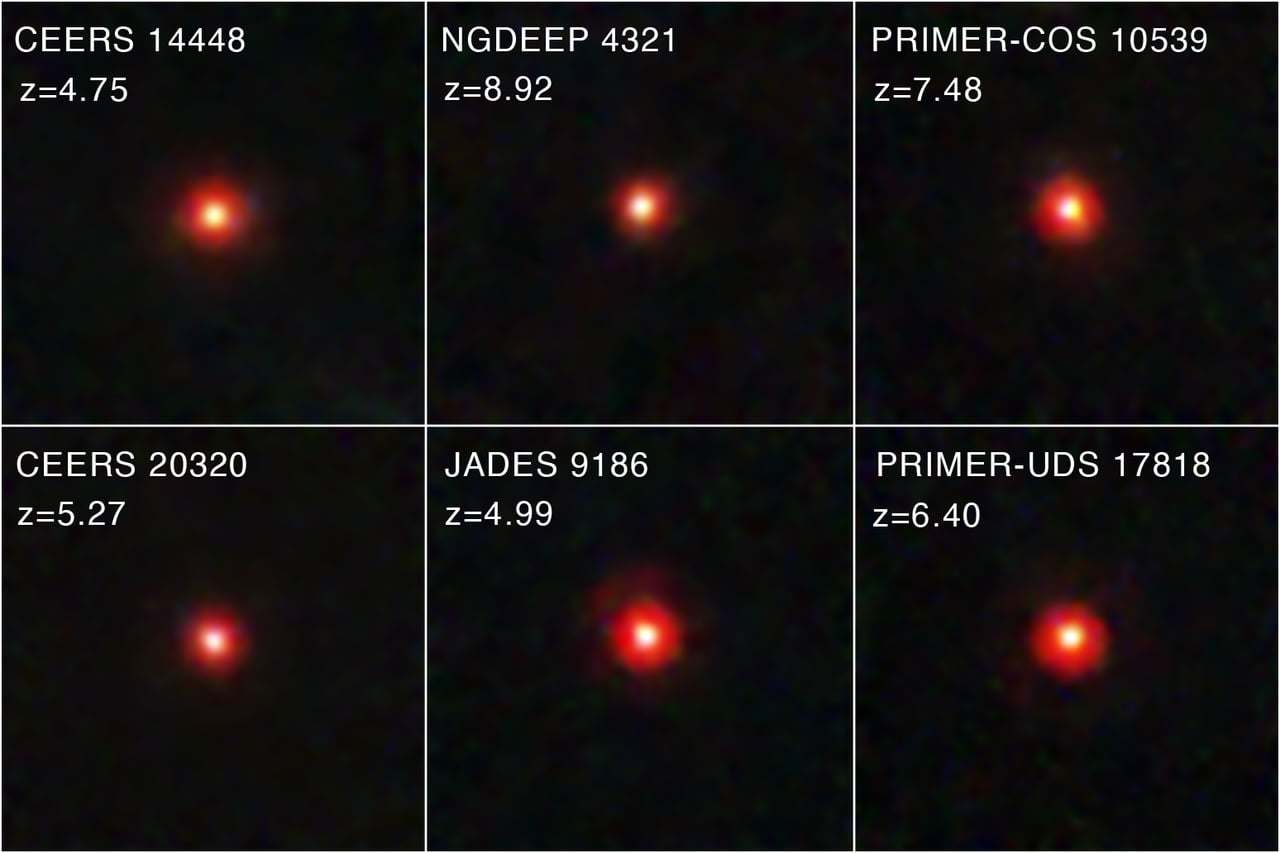
Image: Universe Today
New computer models match observed spectra of JWST's mysterious Little Red Dots to young black holes that grew unusually fast in the infant universe.
Since the James Webb Space Telescope began peering into the earliest, faintest reaches of the cosmos, it has turned up a puzzling population of reddish, point-like objects known as Little Red Dots. Found from an era when the universe was roughly a billion years old, their true nature has divided astronomers.
One leading guess was that Little Red Dots are young active black holes, potential seeds of the first galaxies. But that idea ran into trouble because active black holes typically produce strong radio and X-ray emission, like quasars do, and Little Red Dots show none of that. An alternative theory proposed they were enormous early stars made purely of hydrogen and helium, since their spectra resembled models of primordial stars. That theory also had a problem: the objects show signs of extremely fast rotation, unusual for the universe's first generation of stars.
A new study published in Nature offers a different explanation, built on computer simulations of a young proto-galaxy in the early cosmos. The simulations show that intense ultraviolet radiation bathing gas clouds within the proto-galaxy can prevent the gas from breaking apart into the smaller clumps that normally form stars. Instead, the gas collapses into a single massive primordial star, which then rapidly collapses further into a black hole.
According to the simulations, these black holes begin with a mass around a million times that of the Sun. The same radiation environment that stopped ordinary star formation also funnels gas toward the black hole, letting it feed unusually fast. Black hole growth is normally capped by the Eddington Limit, the point where the heat and light generated by infalling matter push back against further accretion. In this scenario, the surrounding radiation overrides that natural brake, allowing the black hole to consume material at a super-Eddington rate and grow rapidly.
When the researchers modeled the light such an object would emit, the resulting spectrum closely matched real observations of Little Red Dots, capturing why they resemble both black holes and primordial stars in different ways. The findings suggest these dots could be an early developmental stage of galactic black holes, potentially explaining how supermassive black holes and powerful quasars managed to appear so early in the universe's history.
Sources
Little Red Dots Are The Seeds of Quasars and Supermassive Black Holes
Written in Everything Space’s own words by our news-desk model from the sources above, and checked against them in code: every number in this report appears in its sources, and no sentence is copied from them.