
News Desk · Everything Space
Simulation reveals why black hole jets glow brighter at their edges
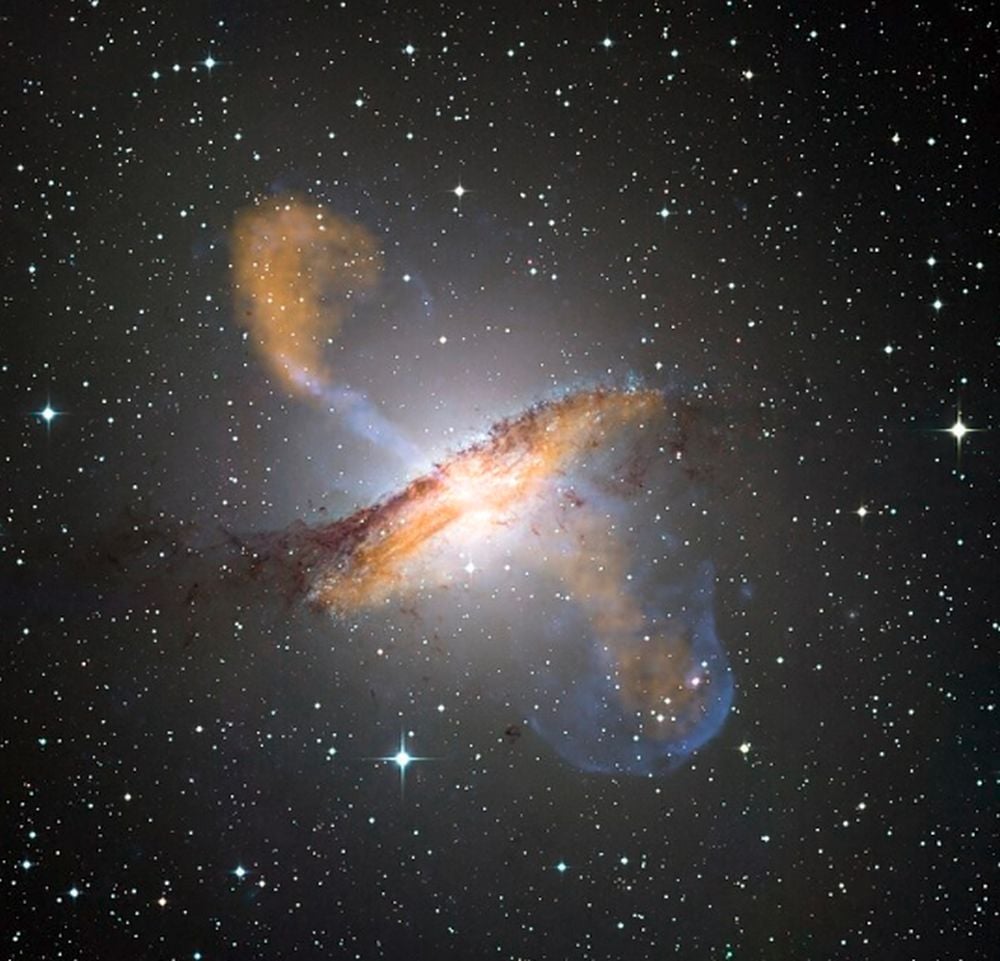
Image: Universe Today
A new plasma physics model explains limb brightening in Centaurus A's jets, a pattern also seen in other galaxies' black holes.
Researchers have proposed an explanation for a puzzling feature of jets launched by supermassive black holes: their edges often glow brighter than their centers, a phenomenon called limb brightening. The finding comes from a new study focused on Centaurus A, the closest radio galaxy to Earth, published in Astronomy and Astrophysics and led by Felix Glaser, a master's student at the University of Würzburg in Germany.
Jets from active supermassive black holes are among the most energetic and long-lived sources of radiation in the universe. They form as material spirals into an accretion disk around the black hole, heats up, and is partly flung outward at relativistic speeds, driven by the black hole's rotation and powerful magnetic fields. These jets can dump enormous energy into surrounding gas, affecting star formation in their host galaxies.
Scientists expected the centers of these jets to be the brightest regions, since that is where energy should be most concentrated. But a decade of observations using the Event Horizon Telescope showed the opposite in Centaurus A, with the jet's edges outshining its core. The same edge-brightening pattern has also been seen in the jets of the galaxies M87 and 3C 84, though each system differs enough that a single explanation has been elusive.
To investigate, the team built a magnetohydrodynamic simulation of a supermassive black hole launching jets, incorporating general relativistic effects and tuning parameters such as black hole mass and viewing angle to match Centaurus A's known properties. The simulation successfully reproduced the edge-brightening pattern seen in real observations.
The researchers attribute the effect to an uneven, or anisotropic, distribution of electron pitch angles within the jet plasma. Because the brightness of synchrotron radiation depends strongly on these pitch angles, the viewing angle relative to the magnetic field can make the jet's edges appear brighter than its core. The team suggests this mechanism may not be unique to Centaurus A but could be common to relativistic jets across the universe.
Study contributors noted that the work demonstrates how microscopic plasma processes can shape structures on enormous cosmic scales, and that upcoming instruments, including the Square Kilometre Array and an upgraded Very Long Array, should allow researchers to probe these plasma effects in greater detail.
The team also pointed out a broader connection: the plasma physics governing black hole jets shares similarities with the physics behind magnetically confined fusion reactors, suggesting that insights from studying Centaurus A's jets could one day inform efforts to develop fusion energy on Earth.
Sources
Black Holes and Their Mysterious Bright Structures Explained
Written in Everything Space’s own words by our news-desk model from the sources above, and checked against them in code: every number in this report appears in its sources, and no sentence is copied from them.