
News Desk · Everything Space
Scientists propose argon isotopes could reveal rock beneath Uranus and Neptune's clouds
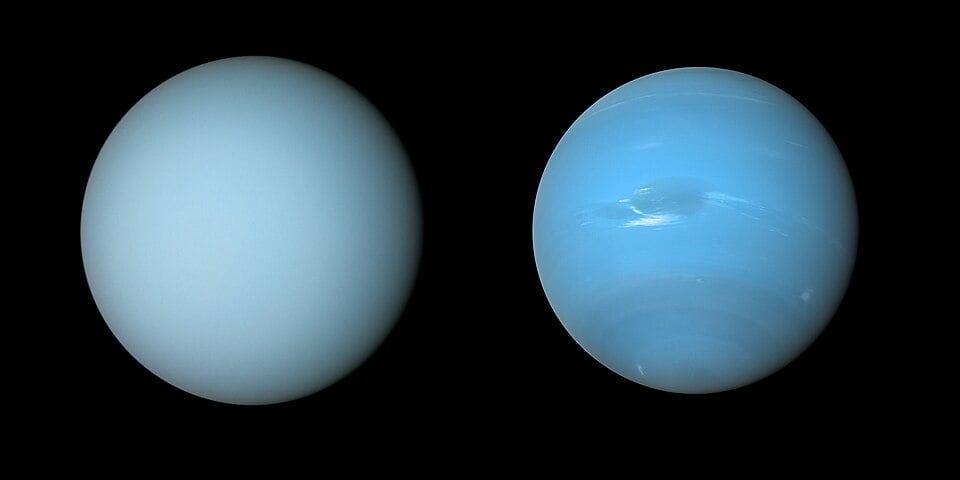
Image: Universe Today
A new study suggests measuring two forms of argon could help a future probe determine whether the ice giants harbor solid rocky interiors.
A new study examines whether a noble gas isotope, argon-40, could help scientists determine whether Uranus and Neptune have hidden rocky material beneath their thick atmospheres, challenging the traditional 'ice giant' classification.
Argon-40 forms when potassium-40, a mildly radioactive and common element found in rocks, decays. Once produced, the inert gas can escape rock and rise into a planet's atmosphere, meaning its presence is often used as evidence of rocky material below the surface on other worlds.
However, the researchers note a complication: argon-40 was also present in the early solar nebula that formed the planets, so some of it may have been captured by Uranus and Neptune during their formation rather than produced by decaying rock. This primordial argon would make it harder to use the gas as a clean indicator of a rocky interior.
How much primordial argon each planet absorbed depends on where it formed relative to the 'argon ice line,' the temperature zone where argon freezes solid or becomes trapped in water ice. Because scientists still debate whether Uranus and Neptune formed near their current positions or migrated outward from closer to the sun, it remains unclear how much of their atmospheric argon is primordial versus rock-derived.
To address this, the study proposes also measuring argon-36, a non-radioactive isotope that is not produced by rock decay. Comparing the two isotopes could let scientists separate the primordial argon contribution from any rock-derived component, since the ratio of the two isotopes in the early solar system is already estimated.
The findings are considered useful preparation for a planned mission to Uranus, the Uranus Orbiter and Probe, which is in development and expected to arrive at the planet in the 2040s. The study's authors suggest that refining these theoretical predictions now could help the mission determine whether the ice giants truly have solid rocky surfaces hidden beneath their atmospheres.
Sources
Are Uranus and Neptune Secretly "Rock Giants"? A Noble Gas Might Hold the Answer
Written in Everything Space’s own words by our news-desk model from the sources above, and checked against them in code: every number in this report appears in its sources, and no sentence is copied from them.