
News Desk · Everything Space
Record 17 spacecraft tracked one solar eruption and found it was strangely lopsided
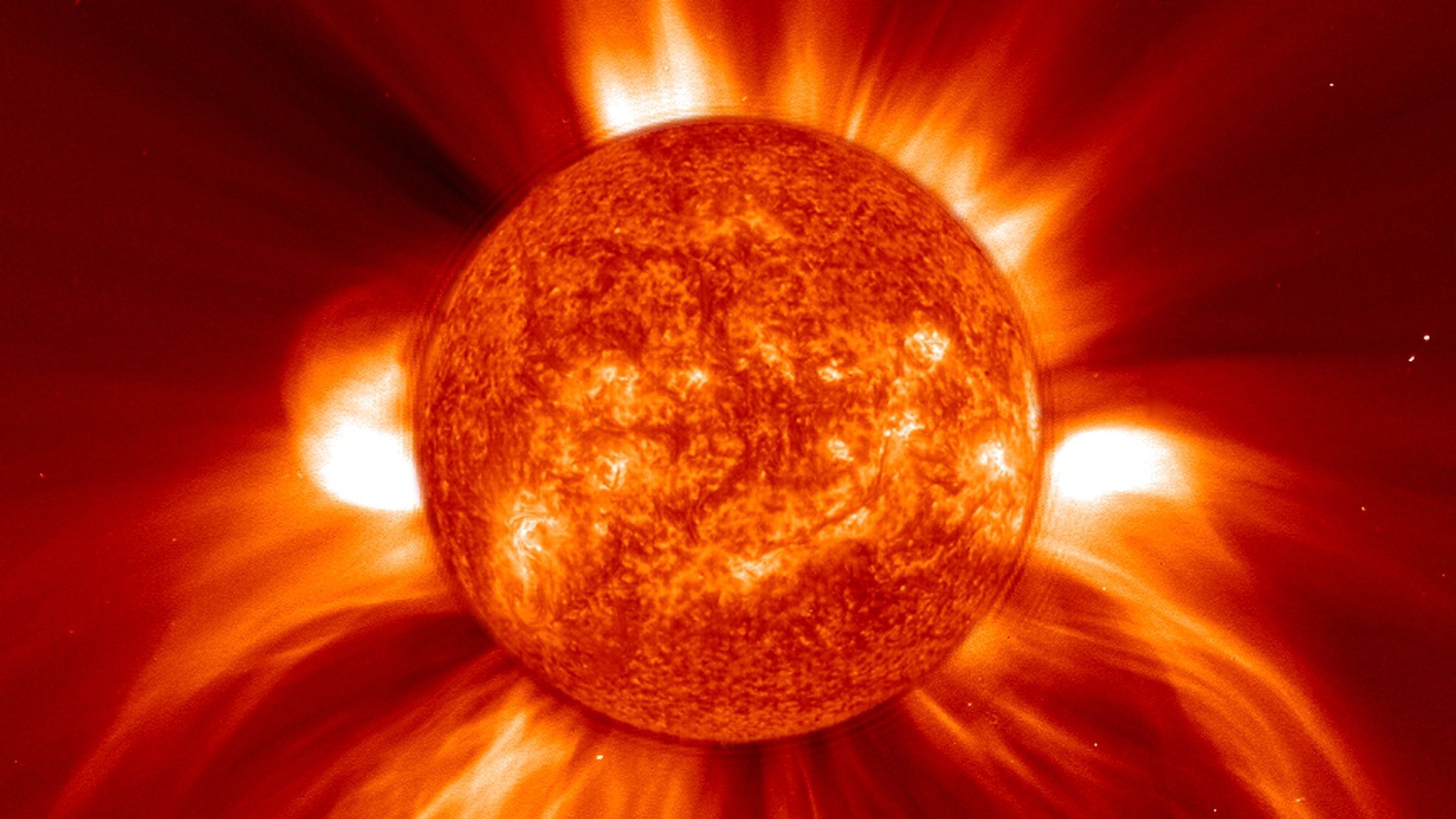
Image: Space.com
The December 2024 coronal mass ejection had two unequal lobes, and the faster one aimed at Earth would have gone unnoticed without observers spread off the sun-Earth line.
A coronal mass ejection that left the sun on Dec. 15, 2024 was followed by 17 different spacecraft scattered across the solar system, and the combined measurements showed the eruption was far from symmetric. The work, led by Adrienn Luspay-Kuti of the Johns Hopkins University Applied Physics Laboratory, was published Aug. 19 in Science Advances.
The previous record for a single CME was 10 spacecraft, most of them strung out along roughly the same line from the sun past Earth, which limited what could be inferred about the cloud's shape. This time observers sat at a range of distances and also well off the sun-Earth line, allowing the eruption to be mapped in two dimensions.
The result was an eruption with two uneven lobes moving at different speeds. A fast lobe traveled through the Earth-Mars sector at an average of about 840 kilometers per second, while a broader, slower lobe headed west toward NASA's STEREO-A spacecraft at roughly 534 kilometers per second, decelerating to about 400 kilometers per second by the time it arrived. Both slowed through friction with the ambient solar wind.
Crucially, the SOHO observatory, which imaged the eruption's onset, saw only the slower, larger lobe; the faster component aimed at Earth was hidden behind it. The Earth-directed lobe was detected on Dec. 17 by a cluster of near-Earth missions, though it was too weak to drive strong auroras. Europe's Solar Orbiter, close to the sun-Earth line at the time, recorded no CME at all, and that absence helped constrain the cloud's geometry. Europa Clipper picked up the fast lobe at 1.19 astronomical units while cruising toward a Mars gravity assist, and MAVEN saw the event at Mars on Dec. 19 and 20.
Luspay-Kuti said a missed CME translates into lost warning time, since fast eruptions can drive shocks that accelerate high-energy particles dangerous to astronauts beyond Earth's magnetic shield. The cause of the asymmetry is not yet understood, and researchers do not know whether such lopsided eruptions are common but under-observed or genuinely rare. Additional off-axis coverage is planned with the European Space Agency's Vigil mission, set to launch in 2031 toward the sun-Earth L5 point.
Sources
How a huge fleet of 17 spacecraft discovered something surprising about solar eruptions
Written in Everything Space’s own words by our news-desk model from the sources above, and checked against them in code: every number in this report appears in its sources, and no sentence is copied from them.