
News Desk · Everything Space
Proposed ELT instrument could probe dark matter puzzle of ultra-diffuse galaxies
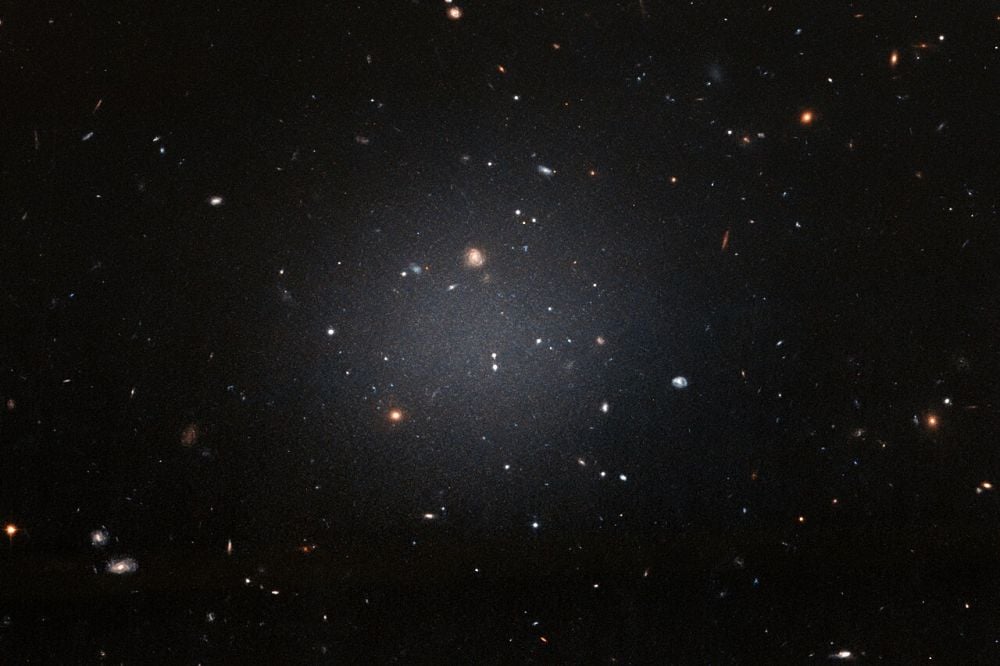
Image: Universe Today
A planned spectrograph for the Extremely Large Telescope could help astronomers determine how unusually puffy, star-poor galaxies form and what that means for dark matter theory.
Researchers have outlined how a proposed instrument for the Extremely Large Telescope, currently under construction and expected to see first light in 2029, could help resolve long-standing questions about ultra-diffuse galaxies and dark matter.
Ultra-diffuse galaxies are roughly the size of the Milky Way but contain far fewer stars, making them puzzlingly faint and spread out. Their existence is difficult to reconcile with the standard cosmological model, since the dark matter halos thought to control galaxy size do not easily explain such diffuse structures.
A new study published in New Astronomy, led by PhD student Marco Mirabile of Italian research institutes INAF-OAAb and GSSI, examines how a near-infrared spectrograph called NEXUS, designed to work alongside an instrument called SHARP on the ELT, could study globular clusters orbiting these faint galaxies. Globular clusters are brighter and more extended than their host galaxies, making them useful tracers of a galaxy's mass and dark matter content.
Current spectroscopic instruments cannot adequately characterize globular cluster populations around distant ultra-diffuse galaxies. The proposed NEXUS instrument would use multi-object spectroscopy to observe many clusters simultaneously, allowing astronomers to measure both the motion of the clusters and their total number, two independent ways of estimating a galaxy's mass.
By comparing these measurements, scientists hope to distinguish between two competing explanations for ultra-diffuse galaxies: that they are failed massive galaxies whose star formation was cut short early on, or that they are ordinary dwarf galaxies that became unusually puffed up over time.
The instrument remains a concept, and this paper argues for its scientific value rather than presenting new observations. If built, the authors say it could serve as a systematic tool for studying faint, low-surface-brightness galaxies and testing the limits of the prevailing dark matter model.
Sources
The ELT Can Probe Ultra-Diffuse Galaxies and Their Dark Matter Mysteries
Written in Everything Space’s own words by our news-desk model from the sources above, and checked against them in code: every number in this report appears in its sources, and no sentence is copied from them.