
News Desk · Everything Space
Parker Solar Probe detects twisted magnetic helicity signals at the solar wind's physics boundary
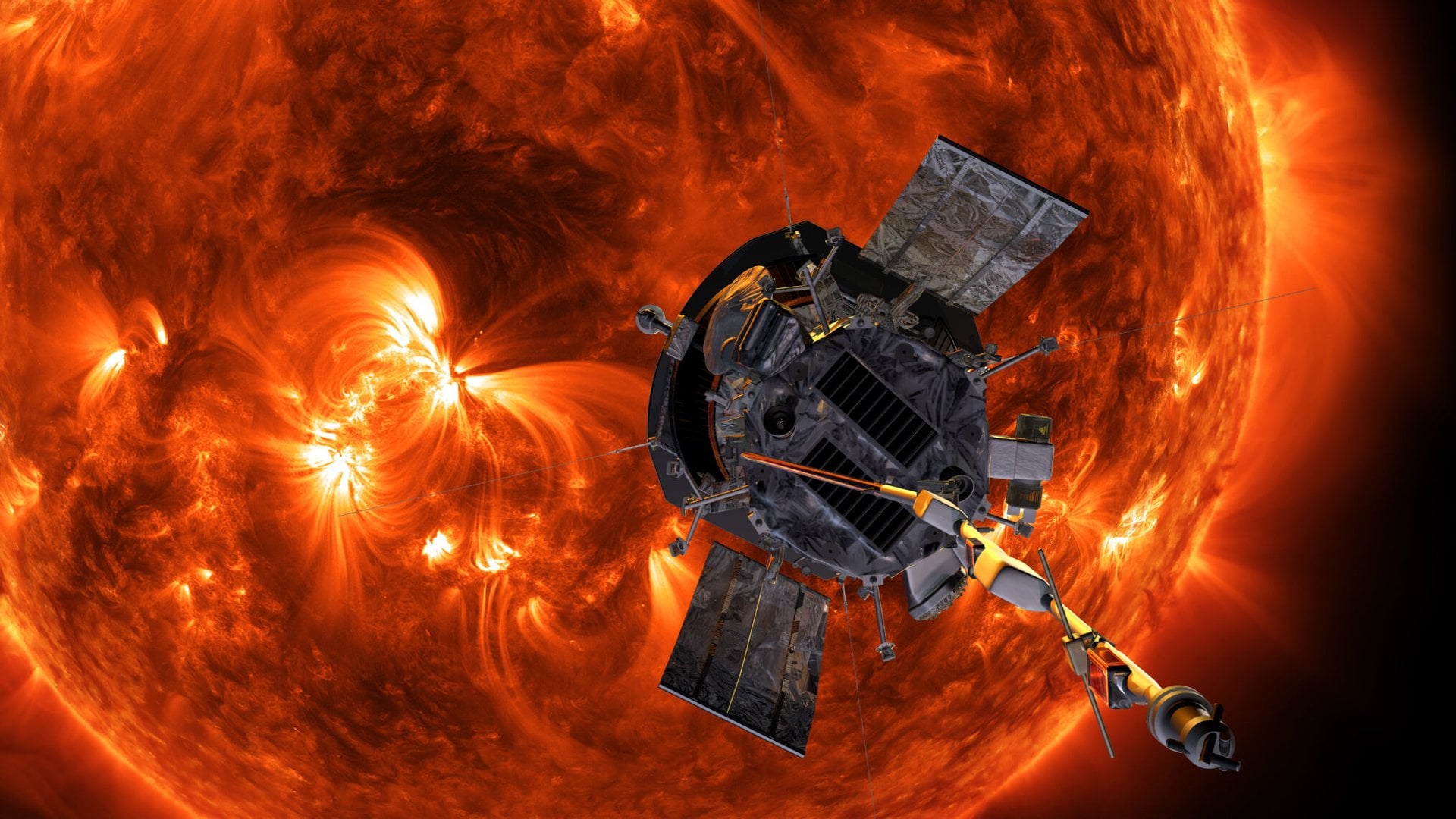
Image: Universe Today
The finding could help explain why the Sun's corona is far hotter than its surface, a decades-old mystery in solar physics.
Researchers analyzing data from the Parker Solar Probe have identified a previously unseen pattern of twisted magnetic structures forming where two different models of the solar wind meet, offering a new clue in the long-standing puzzle of why the Sun's corona is so much hotter than its surface.
Solar physicists typically describe the solar wind using two separate frameworks: one that treats it as a continuous magnetized fluid, and another that models individual charged particles spiraling around magnetic field lines. The two approaches are difficult to reconcile, but understanding their overlap is considered key to explaining how energy transfers through the solar wind and heats the corona.
The team, led by Masatomi Iizawa of the Technical University of Braunschweig, focused on a property called magnetic helicity, which measures the twisting and looping of magnetic field lines and includes a directional quality known as handedness. In most solar wind data this handedness averages out, but Parker's close-up measurements revealed a clear pair of counter-rotating helical signals right at the boundary between the fluid and particle regimes.
Tracking these twisted structures further, the researchers found they behaved unusually: rather than matching the frequency of their immediate surroundings, they showed signs of interacting with structures across a much wider range of scales, from tiny particle-level ripples to large fluid motions. This nonlocal behavior suggests the twists may be linked to a phenomenon called the helicity barrier, in which energy moving through turbulent,
This blockage could help build larger magnetic features, including the switchback structures already observed in the solar wind. The pattern was evident in Parker's data until the solar wind crossed a boundary separating regions of opposite magnetic polarity, at which point the helical signal disappeared.
While the study does not fully resolve the question of coronal heating, it adds a new, measurable feature to the puzzle and shows how high-resolution spacecraft data can expose structure within the Sun's chaotic magnetic environment. Further insights are expected as Parker Solar Probe continues its mission close to the Sun.
Sources
Parker Solar Probe Spots Twisted Magnetic Braids Growing in the Solar Wind
Written in Everything Space’s own words by our news-desk model from the sources above, and checked against them in code: every number in this report appears in its sources, and no sentence is copied from them.