
News Desk · Everything Space
NOM4D demonstrates first automated in-space assembly of a truss structure
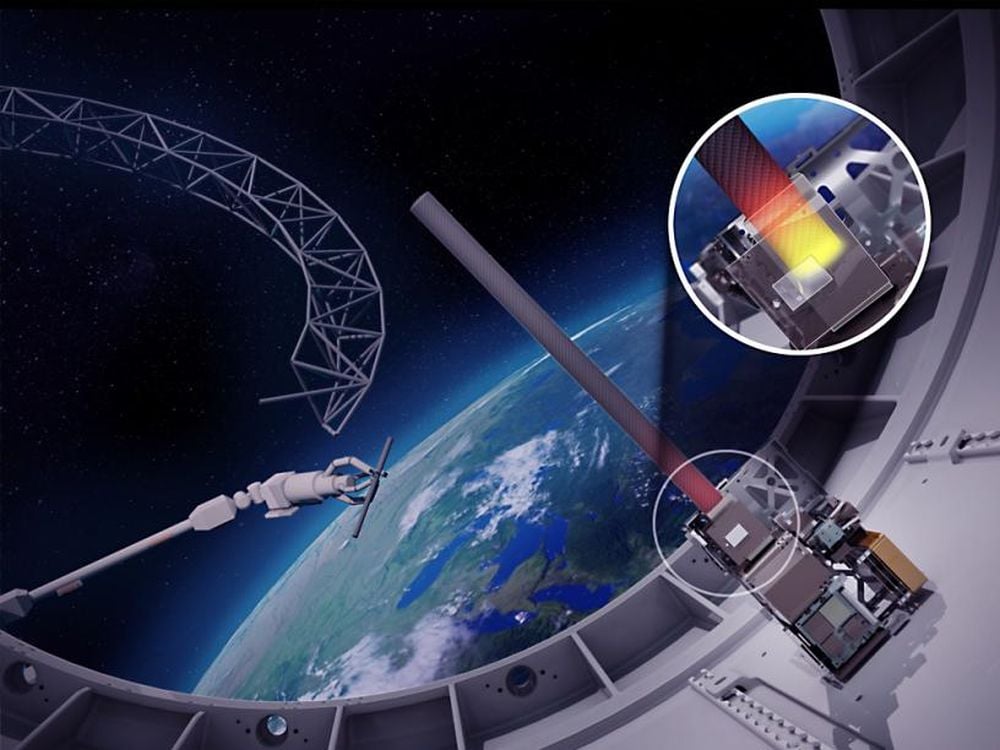
Image: Universe Today
A gantry robot built and meshed a structure in orbit, a step toward constructing large space habitats and antennas without relying on folding designs.
A robotic gantry system has carried out what organizers describe as the first demonstration of fully automated assembly of a structure in space, building a truss-like framework and applying a reflective mesh to it in orbit. The test was conducted under NOM4D, a program focused on manufacturing and assembling large structures directly in space rather than launching them pre-built.
The hardware, developed with Caltech, used a linear robot moving along three axes to join individual truss components at custom joints, piece by piece, while simultaneously attaching a thin reflective mesh similar to what a space antenna might use. Program manager Andrew Detor compared the method to children's construction toys, noting the approach avoids complex robotics or algorithms in favor of straightforward engineering that can scale up.
The goal of the program is to eventually enable construction of structures spanning hundreds of meters to kilometers, sizes that cannot be achieved with current launch methods. Rocket fairings limit how large a single payload can be, and solutions like JWST's folding design work for some missions but are not practical for every structure. Assembling modular components after launch offers an alternative path to building much larger systems.
The timeline for this demonstration moved faster than originally planned. What was meant to be a phase of additional ground testing was instead redirected toward an orbital demonstration, with the payload launched by SpaceX. Detor said the team went from conceiving an orbital demo to launching a working prototype in about 15 months, a pace he attributes to the urgency of validating the technology in the harsh conditions of actual spaceflight rather than only in the lab.
A follow-up test is planned through a separate university partner, which will send a project to the International Space Station to test composite material processing. That demonstration would use a resin heated through an energy-efficient method to form a strong polymer structure in space, similar to techniques used in composite manufacturing on Earth.
Program leaders see the recent demonstration as an early step rather than a finished capability, raising the possibility of eventually constructing large depots, habitats, solar arrays, or antennas in orbit. Such capabilities could also support concepts like lunar lava tube habitats or crater-based telescopes that depend on assembling components rather than launching a single large finished structure.
Sources
Automated Assembly in Space is the Future and NOM4D is Showing the Way
Written in Everything Space’s own words by our news-desk model from the sources above, and checked against them in code: every number in this report appears in its sources, and no sentence is copied from them.