
News Desk · Everything Space
New software reveals giant exoplanet hidden in James Webb telescope data
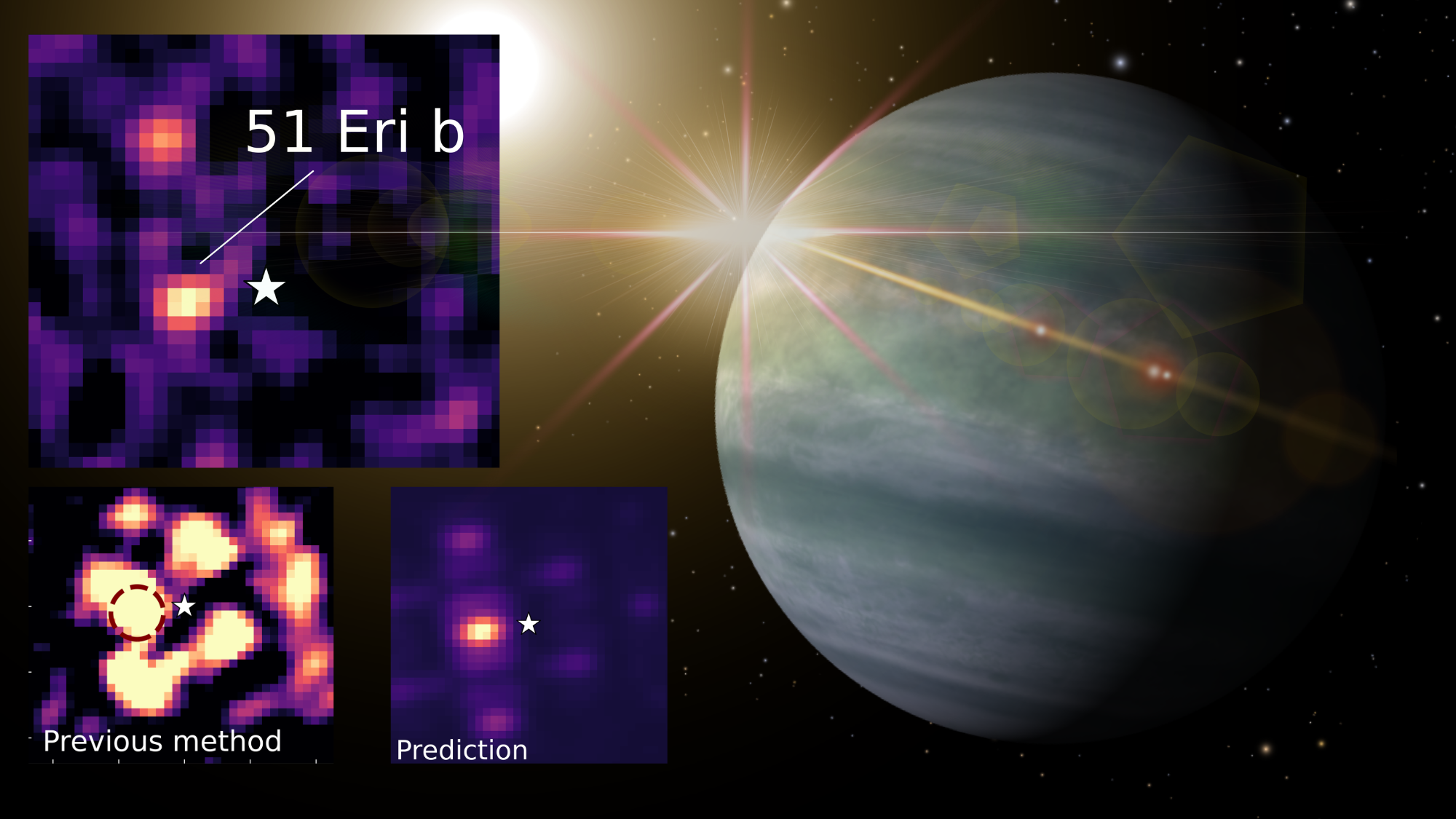
Image: Space.com
A digital 'twin' of the telescope cancels out starlight glare, uncovering a known exoplanet missed in earlier observations and promising better future planet hunts.
Astronomers have recovered a previously undetected giant exoplanet from existing James Webb Space Telescope data by using a new technique that models the telescope's own imperfections to strip away glare from its host star.
The planet, 51 Eridani b, is a gas giant roughly 11 times the mass of Jupiter orbiting a star about 97 light-years away. It was first discovered in 2015 using ground-based telescopes, but did not show up in JWST observations of the same system, not because of any flaw in the telescope, but because light from its host star overwhelmed the planet's faint signal.
Directly imaging exoplanets is notoriously difficult since planets are vastly fainter than their stars. Even with a coronagraph blocking most starlight, enough residual glare remains to hide planets. Traditional fixes involve comparing images of a reference star to subtract out unwanted light, but tiny vibrations in a telescope's instruments, caused by things like cooling systems, introduce further scattering that conventional methods struggle to remove.
To address this, researchers at Northwestern University developed a technique called Physics-based Learning for Imaging Planets, which builds a virtual replica of the telescope that simulates exactly how starlight travels through its mirrors and optics. This digital twin is adjusted until it matches real observations, allowing scientists to subtract the simulated glare and reveal fainter objects underneath.
Testing the method on JWST data from two known planetary systems and one system without known planets, the team found it outperformed standard techniques by two to 15 times in sensitivity. That improvement allowed 51 Eridani b to emerge from data collected two years earlier.
Researchers say the approach could help other astronomers find exoplanets previously obscured by their stars' glare, and could be especially valuable for NASA's planned Habitable Worlds Observatory, which aims to directly image Earth-like planets around sun-like stars. The team noted that no solar-system-like planetary arrangements have yet been found elsewhere, a gap they attribute to limits in observing technology rather than the absence of such systems.
The findings were published this week in the journal Nature.
Sources
Giant exoplanet emerges from the dark when the James Webb Space Telescope turns out the starlight
Written in Everything Space’s own words by our news-desk model from the sources above, and checked against them in code: every number in this report appears in its sources, and no sentence is copied from them.