
News Desk · Everything Space
New orbiter images reveal purple and pink hues near Mars' south pole
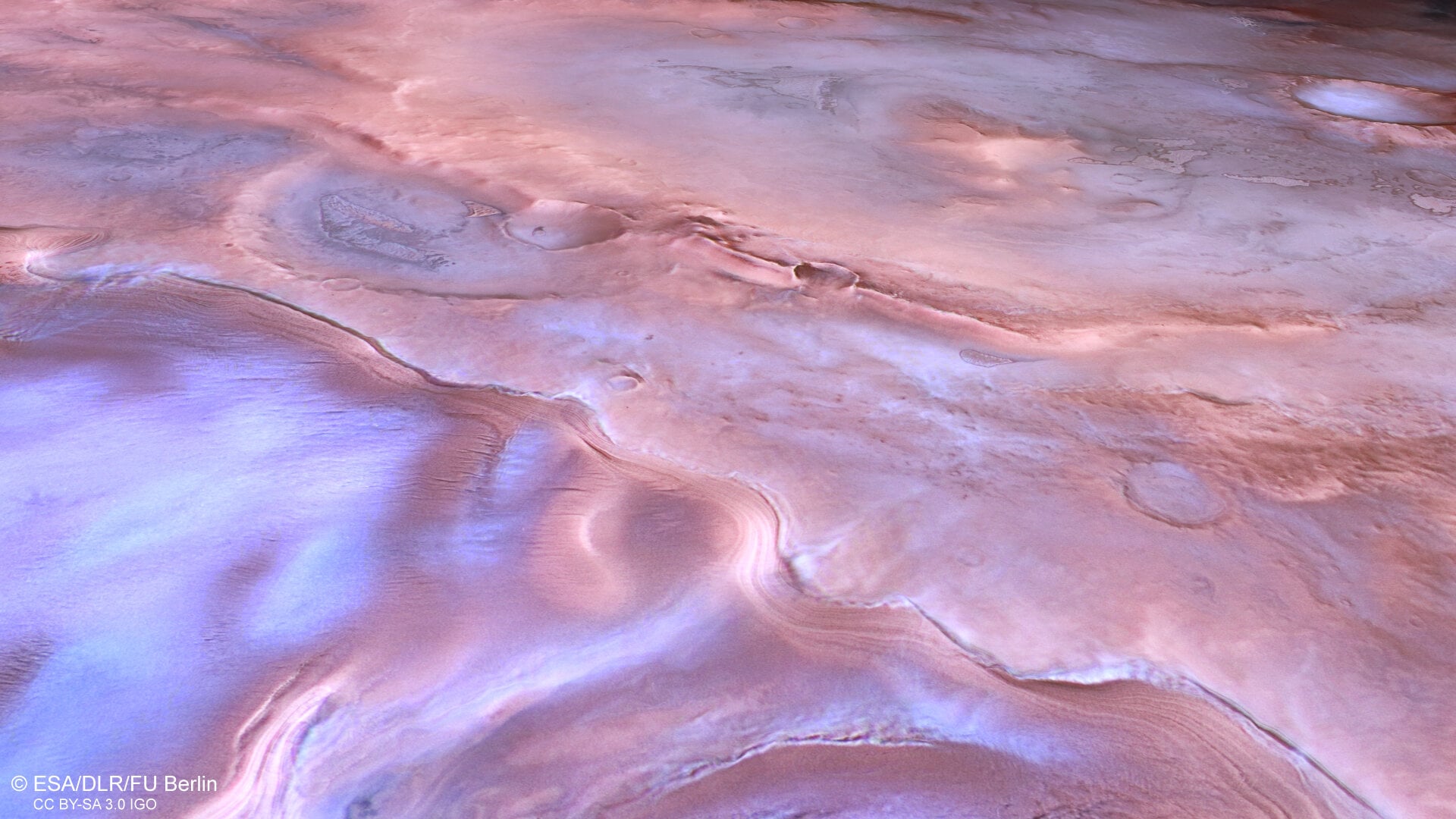
Image: Universe Today
Colorful Martian terrain around the Thyles Rupes cliff formation reveals how volcanic minerals, frost, and dust combine to reshape the Red Planet's usual palette.
New images from Mars orbiters show an unexpected purple and pink landscape near the planet's south pole, contrasting with the reds and browns that typically define the Martian surface. The colorful region includes a towering ice-covered cliff formation called Thyles Rupes, which rises more than a kilometer above the surrounding terrain.
The varied colors come from different geological sources. Dark material in the region was created and spread by ancient volcanic activity and is rich in minerals such as olivine and pyroxene, both also common in Earth's mantle. Pale bluish patches, including part of the south polar cap, are covered in frozen carbon dioxide that can persist even during the Martian spring when the images were taken.
The overall purplish appearance of the scene results from a mix of dust and frost rather than a single material. Because lighting, airborne dust, and surface frost all shift throughout the day, the coloring of the region is not constant and can look markedly different depending on when it is observed.
The imagery also captures a mix of dune types shaped by inconsistent winds, including arc-shaped ridges with distinctive horn-like ends, rather than the more uniform dune fields seen elsewhere on Mars. Nearby impact craters of varying ages help researchers piece together the sequence of events in the region, showing which features are older or younger than Thyles Rupes.
Unlike mountain ranges on Earth, which form through ongoing tectonic activity, Thyles Rupes likely formed as Mars' interior cooled and its rigid, single-plate crust contracted, pushing sections of terrain upward. Because Mars lacks active plate tectonics, such features offer insight into how single-plate rocky worlds evolve over time.
The images add to decades of surface observations gathered by orbiting spacecraft equipped with high-resolution cameras, which continue to reveal new details about Martian geology even though the planet is no longer geologically active in the way Earth is.
Sources
Written in Everything Space’s own words by our news-desk model from the sources above, and checked against them in code: every number in this report appears in its sources, and no sentence is copied from them.