
News Desk · Everything Space
New models suggest hypernovas may not be needed to explain unusual star compositions
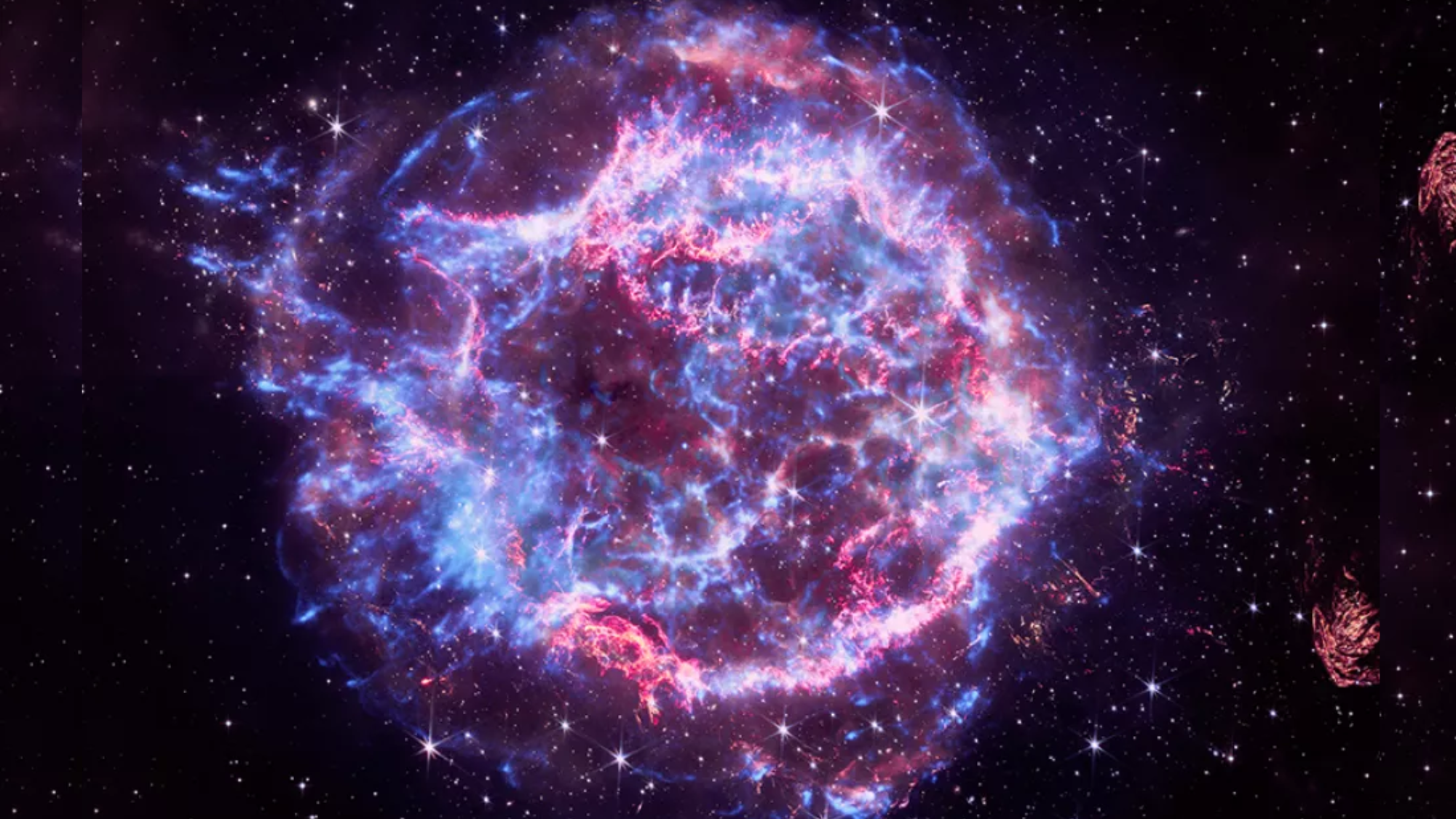
Image: Space.com
Researchers find that lopsided ordinary supernova explosions, not ultra-powerful hypernovas, can account for stars with strange chemical makeups.
Researchers have challenged the existence of hypernovas, extremely powerful stellar explosions once proposed to explain certain unusual stars found in the Milky Way's halo and a nearby dwarf galaxy. The team argues that ordinary supernovas, when their explosions are modeled as uneven rather than symmetrical, can account for these stars just as well.
Hypernovas were theorized as explosions roughly ten times more energetic than typical supernovas, thought necessary to produce stars with an unusual mix of elements. The new study built mathematical models accounting for the fact that real supernovas don't scatter their material evenly, with different elements like oxygen and sulphur flying off in different directions. When this asymmetry was factored in, the researchers found that ordinary supernovas could produce the same unusual chemical signatures previously attributed to hypernovas.
Supernovas occur when massive stars exhaust their nuclear fuel, causing their cores to collapse and triggering explosive shockwaves that scatter the elements forged during the star's life. Hypernovas were thought to arise from even more massive, rapidly spinning stars, producing far more energetic blasts. Because exploding stars distribute their elements unevenly, the chemical makeup of later-generation stars formed from that debris can reveal clues about the explosion that created them.
The team tested their approach on four stars previously suspected to have formed from hypernova debris, finding that three were more likely products of ordinary supernovas. They also examined a red giant star in the Milky Way's halo with an unusual abundance of heavy elements such as silver and uranium, which are typically linked to either hypernovas or neutron star mergers. After ruling out a neutron star merger alone based on missing elements, the team concluded this star likely originated from a metal-poor dwarf galaxy, shaped by a combination of a neutron star merger and an ordinary, asymmetrical supernova.
The researchers say their findings indicate that incomplete mixing of supernova ejecta needs to be factored into models of how chemical elements evolve within galaxies. The work was published as two papers in a peer-reviewed astronomy journal.
Sources
Scientists discover that some of the universe's biggest explosions may have never happened at all
Written in Everything Space’s own words by our news-desk model from the sources above, and checked against them in code: every number in this report appears in its sources, and no sentence is copied from them.