
News Desk · Everything Space
New images reveal fine knotted filaments in ancient Pa 30 supernova remnant
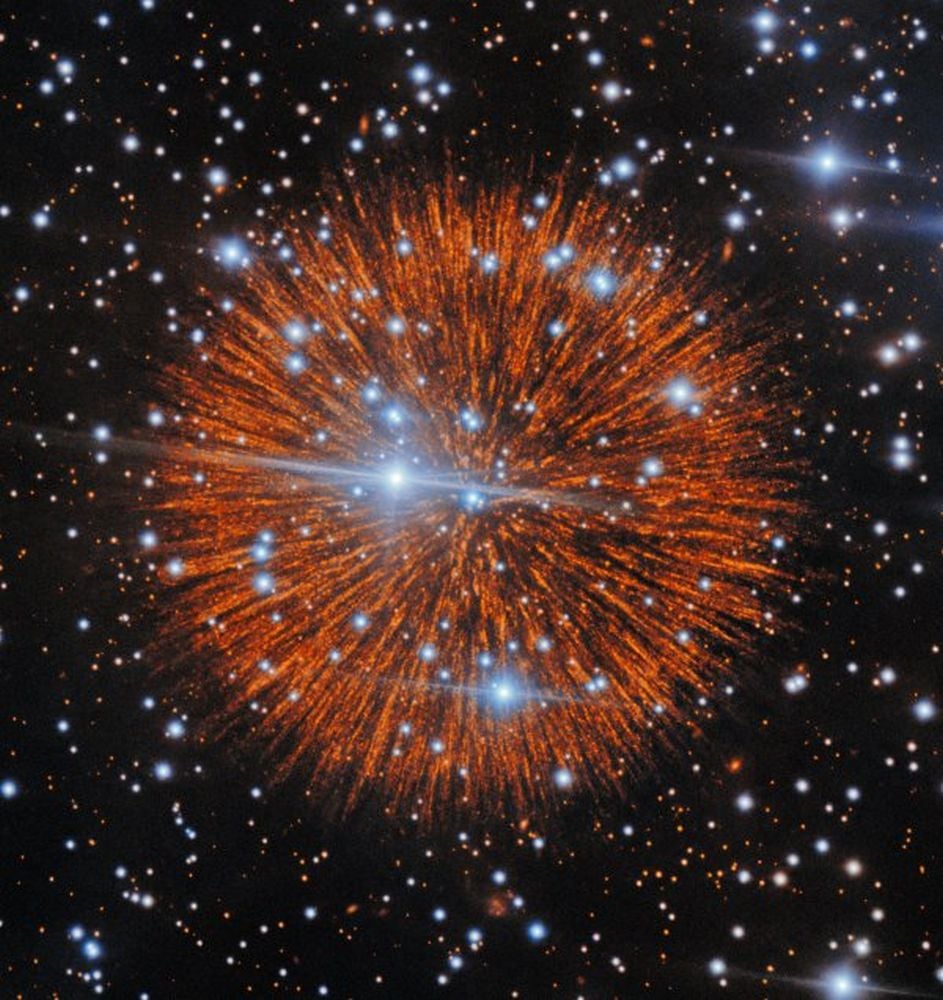
Image: Universe Today
Deep Gemini North observations of the 1181 'guest star' remnant show unexpected structure and a central white dwarf that barely moved after the explosion.
Astronomers using the Gemini North Telescope have captured far more detailed images of Pa 30, the remnant of a supernova recorded by Chinese and Japanese observers in 1181. The new images, taken with the Gemini Multi-Object Spectrograph, reveal roughly ten times more filament structure than earlier observations had shown.
Pa 30 is considered the only known supernova remnant in the Milky Way linked to a historically documented 'guest star,' making it an unusually valuable target since its age and origin point are already established. Researchers believe the explosion was not a typical core-collapse supernova from a dying massive star, but rather a Type Iax event caused by the merger of two white dwarfs.
The new observations, focused on emission from singly-ionized sulfur, showed that the remnant's filaments are not smooth streaks but chains of distinct knots and clumps. The team says this patchy structure reflects variations in the density and temperature of the surrounding material that the expanding debris slammed into after the explosion.
The sulfur-based images showed considerably more detail than previous observations made using doubly-ionized oxygen, giving researchers a clearer picture of the remnant's complex structure.
At the center of the nebula sits an unusual white dwarf, potentially exceeding the normal mass limit for such stars and exhibiting extremely high temperatures and very fast stellar winds. Unlike most supernova remnants, where the surviving stellar remnant is kicked away from the nebula's center by the explosion, Pa 30's white dwarf appears to remain close to the nebula's center, suggesting it did not receive a strong sideways kick.
The researchers say follow-up observations, including with the Hubble Space Telescope, could help clarify the processes behind the explosion and the remnant's unusual shape. They also note that since reliable historical skywatching records only span about a thousand years, other similar remnants may still be hiding undiscovered in the galaxy, and future telescopes may help uncover them.
Sources
Astronomers Uncover More Intriguing Detail in an Ancient Supernova Remnant
Written in Everything Space’s own words by our news-desk model from the sources above, and checked against them in code: every number in this report appears in its sources, and no sentence is copied from them.