
News Desk · Everything Space
LOFAR produces deepest-ever low-frequency radio map of the sky
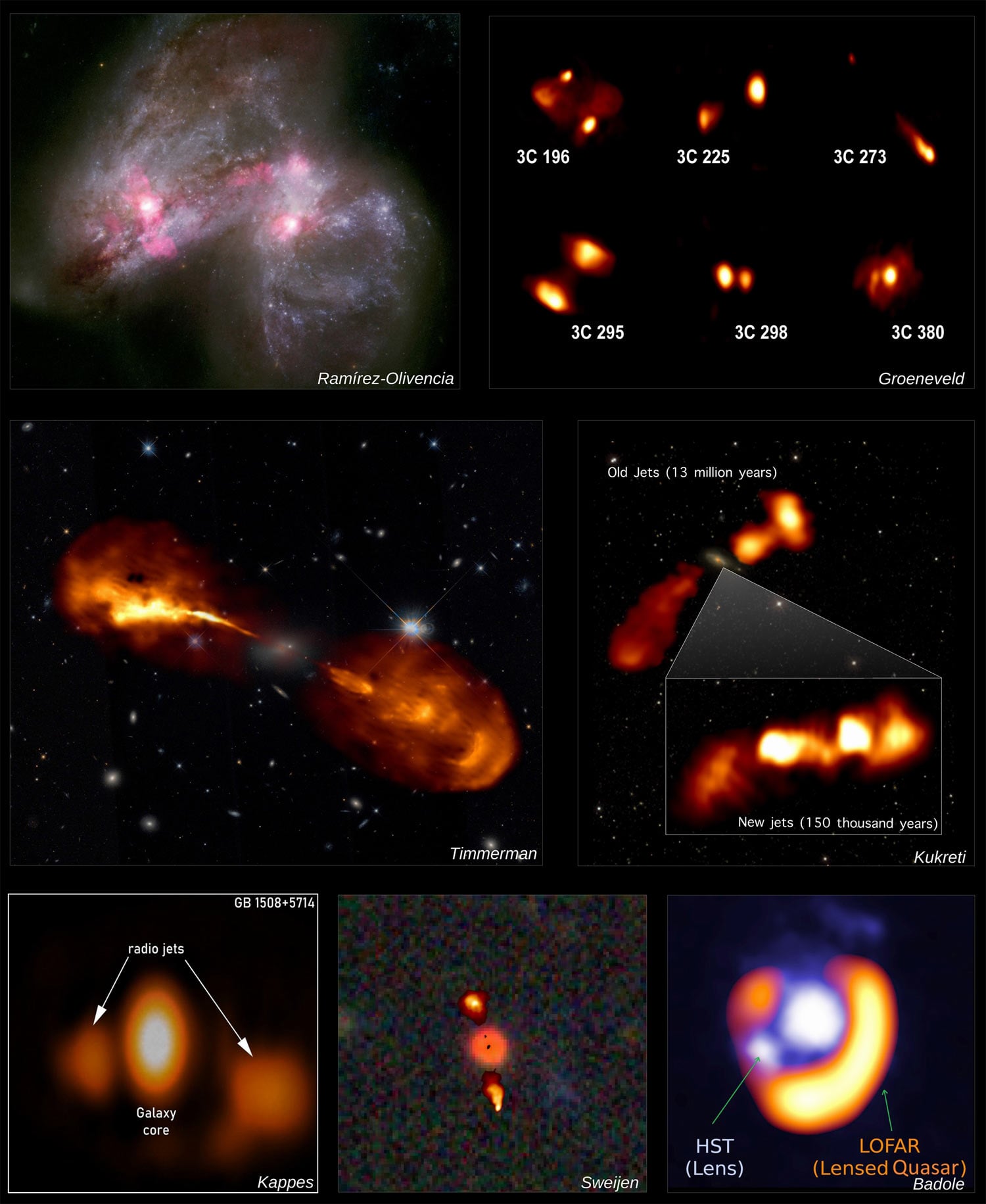
Image: Universe Today
A new survey of the ELAIS-N1 field reveals tens of thousands of radio sources with twenty times sharper resolution than before, previewing capabilities of the upgraded LOFAR2.0.
Astronomers led by a team at Leiden University have released the most detailed low-frequency radio image yet produced, using the LOFAR telescope array to observe a patch of sky called ELAIS-N1. The region was chosen because it contains little obscuring dust, gas, or starlight, making it ideal for peering deep into the distant universe.
The resulting image contains about 63,000 radio sources, including quasars and actively star-forming galaxies, and achieves twenty times the resolution of an earlier LOFAR image of the same field. The improvement stems from advances in interferometry, the technique of combining signals from multiple telescopes into a single sharp image.
Producing the image required processing roughly 200 hours of observations amounting to 400 terabytes of data, compiled into an eight-billion-pixel picture. Such a large dataset would have been impossible to handle at this resolution only a few years ago, but a data-processing platform called Spider, developed with the Netherlands Institute for Radio Astronomy and partners, along with improved calibration methods, cut processing time by a factor of ten, allowing the full dataset to be processed in a matter of months.
The high sensitivity of the observations also revealed fine filament structures around radio galaxies, particularly near galaxy clusters, along with details of their shapes and spectral properties. Capturing these features required combining high-resolution imaging with low-frequency data, a combination LOFAR is particularly suited for.
Active galactic nuclei, the luminous cores of galaxies powered by supermassive black holes, stand out prominently in the image, including the relativistic jets of superheated material they emit. Where earlier, lower-resolution surveys showed these objects as indistinct blobs, the new data let scientists trace individual jets and sources in detail, offering fresh opportunities to study how these jets evolve and interact with their surroundings.
The image also highlights small, young galaxies undergoing vigorous star formation, which radio observations can detect through the gas and dust that block visible and infrared light. This offers insight into how early galaxies evolved into the larger, more mature galaxies seen in the universe today.
The research team says the project demonstrates the capability that will be expanded by the upcoming LOFAR2.0 upgrade, intended to produce wider and sharper images and keep the telescope competitive with next-generation observatories such as the Square Kilometer Array. Combining this radio data with observations at other wavelengths, including optical, infrared, and X-ray, will help astronomers determine the distances and masses of the detected sources.
Sources
LOFAR Takes the Deepest Image of the Low-Frequency Radio Sky to Date
Written in Everything Space’s own words by our news-desk model from the sources above, and checked against them in code: every number in this report appears in its sources, and no sentence is copied from them.