
News Desk · Everything Space
JWST-observed star clusters may be birthplaces of intermediate-mass black hole seeds
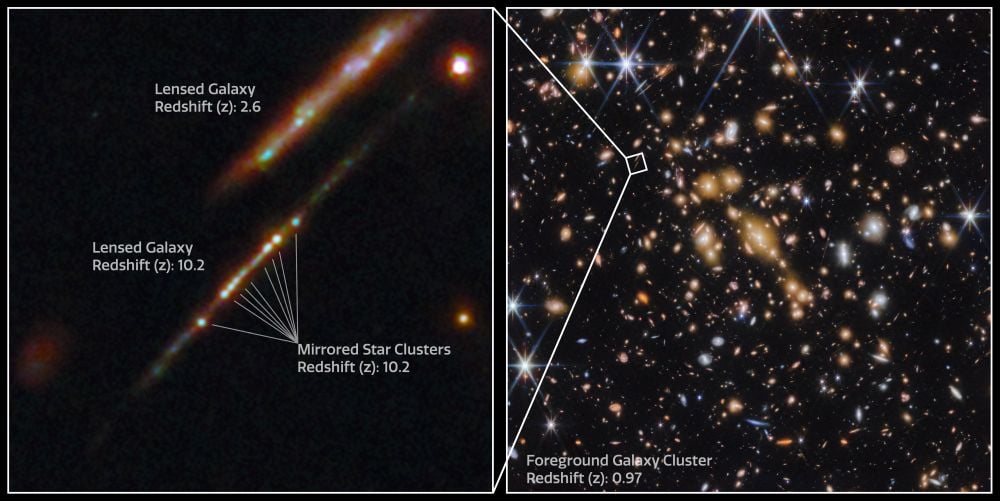
Image: Universe Today
A new study suggests dense, metal-poor clusters spotted by JWST in the early universe could spawn intermediate-mass black holes that grow into today's supermassive black holes.
Astronomers have proposed a possible answer to a long-standing gap in black hole formation theory: where the seeds of supermassive black holes come from. A new study examining dense star clusters spotted by the James Webb Space Telescope in two early, gravitationally lensed galaxies suggests these clusters could be natural factories for intermediate-mass black holes, which sit between stellar-mass and supermassive scales.
The clusters, found in the Cosmic Gems arc and the Firefly Sparkle galaxy, were imaged by JWST when the universe was only a few hundred million years old. Researchers modeled how runaway stellar collisions and mass loss from stellar winds within these ultra-dense clusters could produce black holes ranging from about 100 to several thousand solar masses, checking their results against detailed simulations of compact clusters.
The compact, metal-poor Cosmic Gems clusters produced the heaviest black holes in the study, reaching into the thousands of solar masses. Low metal content appears key, since it limits the mass stars lose through stellar winds, allowing more material to funnel into growing black holes. The more spread-out clusters in Firefly Sparkle yielded lighter black holes, closer to the lower bound of what counts as intermediate mass.
The heavier end of these estimated black hole masses falls into what researchers call the 'heavy seed' category, which could help explain how supermassive black holes grew so quickly in the early universe. The findings may also be relevant to understanding JWST's recently discovered 'Little Red Dots,' compact red objects whose light signatures suggest they may be powered by supermassive black holes.
The study is not a direct observation of any intermediate-mass black hole, but rather a demonstration that the environments needed to form one existed in the early universe. The authors acknowledge unknowns, including the clusters' rotation, internal structure, and the distribution of stellar masses within them, any of which could shift the predicted black hole masses. Further research is expected to refine these estimates and test whether such clusters truly serve as the missing link between stellar remnants and the supermassive black holes seen in galaxies today.
Sources
Written in Everything Space’s own words by our news-desk model from the sources above, and checked against them in code: every number in this report appears in its sources, and no sentence is copied from them.