
News Desk · Everything Space
JWST finds interstellar comet 3I/ATLAS made of unusually dusty ice grains
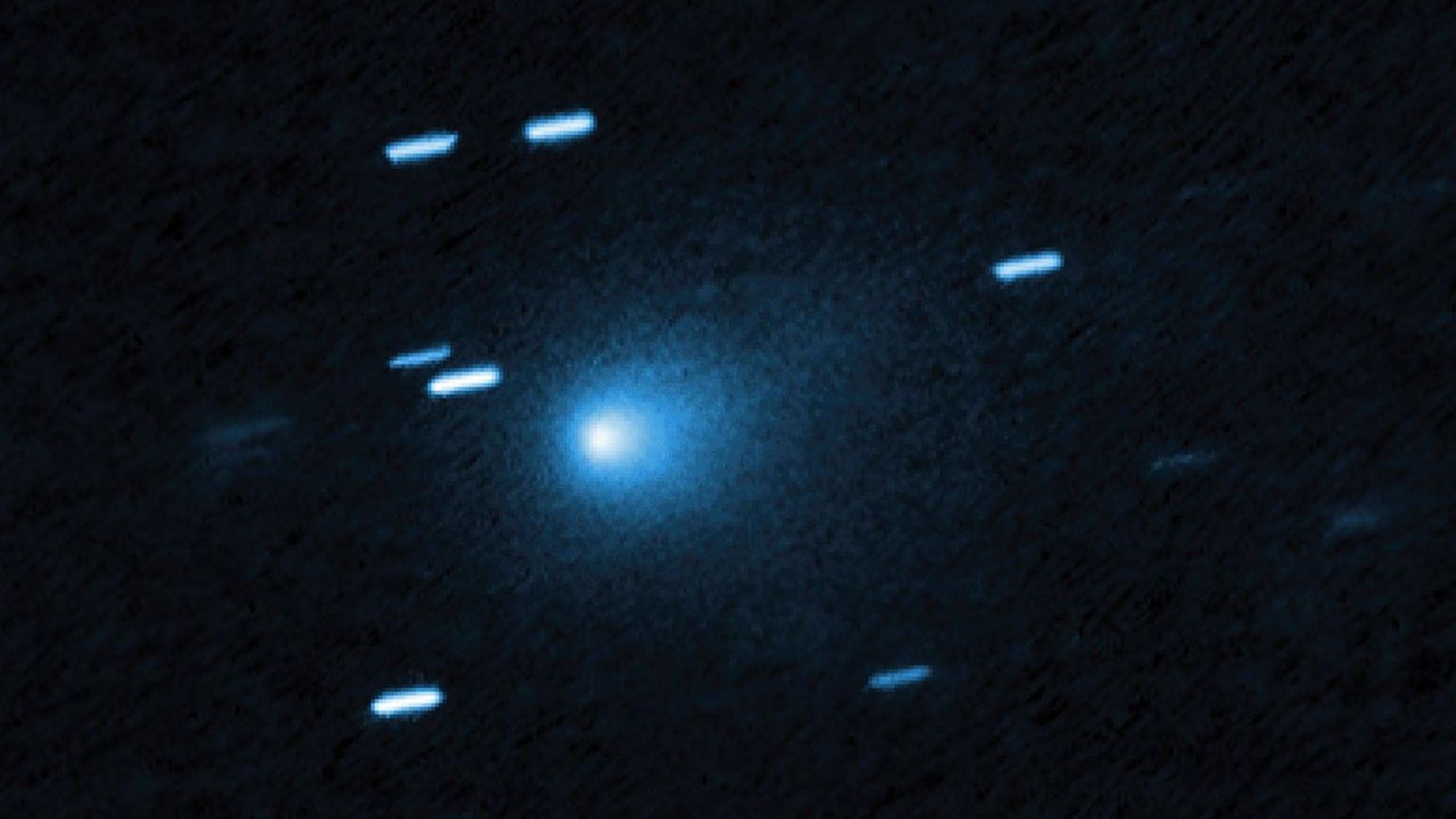
Image: Space.com
The composition links the rare interstellar visitor to icy bodies beyond Neptune, hinting at shared planet-building materials across star systems.
New observations from the James Webb Space Telescope show that interstellar comet 3I/ATLAS is made of tiny ice grains mixed with unusually high amounts of dust, setting it apart from comets native to our solar system.
3I/ATLAS was spotted entering the solar system in 2025, only the third known interstellar object after 'Oumuamua and Borisov. Its arrival gave astronomers a rare opportunity to study material formed around another star, and JWST was positioned to track it closely.
Using its NIRSpec instrument, JWST observed the comet three times, before and after its closest approach to the sun. While a strong water-ice signal appeared at three microns, the fainter signals typically seen at 1.5 and two microns were missing, an unusual pattern that puzzled researchers.
Modeling of this spectral pattern suggests the comet's ice grains are coated in significant dust, unlike the cleaner, near-pure water-ice grains found in solar system comets. Researchers say this dust content offers a clue to the environment in which the comet originally formed.
The comet's spectrum also resembles that of certain mid-sized trans-Neptunian objects, icy bodies orbiting far beyond Neptune that are rich in carbon dioxide ice and organic material. Earlier JWST data had already shown 3I/ATLAS has an especially high carbon dioxide content for a comet.
Because comets preserve primordial material from the disks of gas and dust that surround forming stars, their composition offers insight into planet formation. The resemblance between 3I/ATLAS and trans-Neptunian objects suggests that icy building blocks around other stars may share similar characteristics with those that formed our own solar system, possibly varying mainly in how dusty or pure the ice grains are.
The findings imply that small, icy grains form early within planet-forming disks before becoming part of larger bodies such as comets and protoplanets, whether around our sun or other stars.
Sources
Written in Everything Space’s own words by our news-desk model from the sources above, and checked against them in code: every number in this report appears in its sources, and no sentence is copied from them.