
News Desk · Everything Space
JWST finds brown dwarfs as light as two Jupiters, revealing a new spectral class
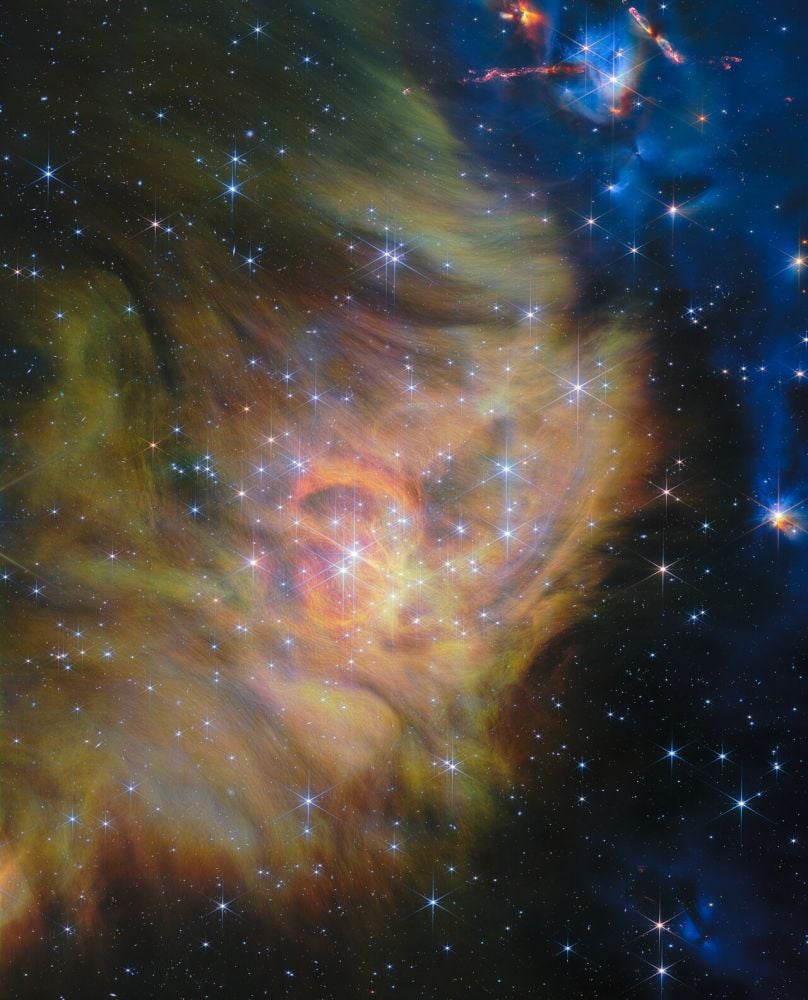
Image: Universe Today
The discovery pushes the known lower mass limit of star formation and identifies an unexplained chemical fingerprint in the coolest known brown dwarfs.
Astronomers using the James Webb Space Telescope have identified a set of extremely low-mass brown dwarfs in the star-forming region IC 348, some weighing as little as about two Jupiter masses, expanding what is known about the smallest objects that can form the way stars do.
The research, led by Kevin Luhman of Penn State and Catarina Alves de Oliveira of the European Space Agency, surveyed IC 348, a young cluster roughly 1,000 light years away within the Perseus Molecular Cloud. Because of its proximity, the region is well suited for spotting extremely faint, low-mass objects.
The team identified 39 new candidate brown dwarfs and obtained detailed spectra for 15 of them. Nine were confirmed as true brown dwarfs, objects too small to sustain hydrogen fusion. The faintest of these had an estimated mass near two Jupiter masses, setting a new benchmark for how small a star-like object formed by cloud collapse can be.
A key finding involves an unusual absorption feature in the spectra linked to a hydrocarbon compound not predicted by existing atmospheric models and not previously seen in objects outside the solar system. This feature had already appeared in earlier observations of brown dwarfs in the same cluster, and its recurrence across a larger sample convinced the researchers it is a genuine characteristic of the coolest brown dwarfs rather than a fluke.
Based on this pattern, the team proposed a new spectral classification, tentatively called class H, defined by the presence of this hydrocarbon absorption feature.
Two of the newly identified objects, including one near two Jupiter masses, also showed strong excess emission suggesting they are surrounded by disks of material, indicating they retain the ingredients needed to form planets of their own, blurring the boundary between low-mass stars and planetary systems.
The findings add to a growing body of JWST-driven results probing the faint edges of star formation and add fresh material for testing models of how the smallest gravitationally bound objects come to exist.
Sources
Webb Searches for Brown Dwarfs in a Stunning Star-Forming Region
Written in Everything Space’s own words by our news-desk model from the sources above, and checked against them in code: every number in this report appears in its sources, and no sentence is copied from them.