
News Desk · Everything Space
JAXA's MMX mission to Phobos set to launch around Oct. 19 carrying Planetary Society-backed sampler
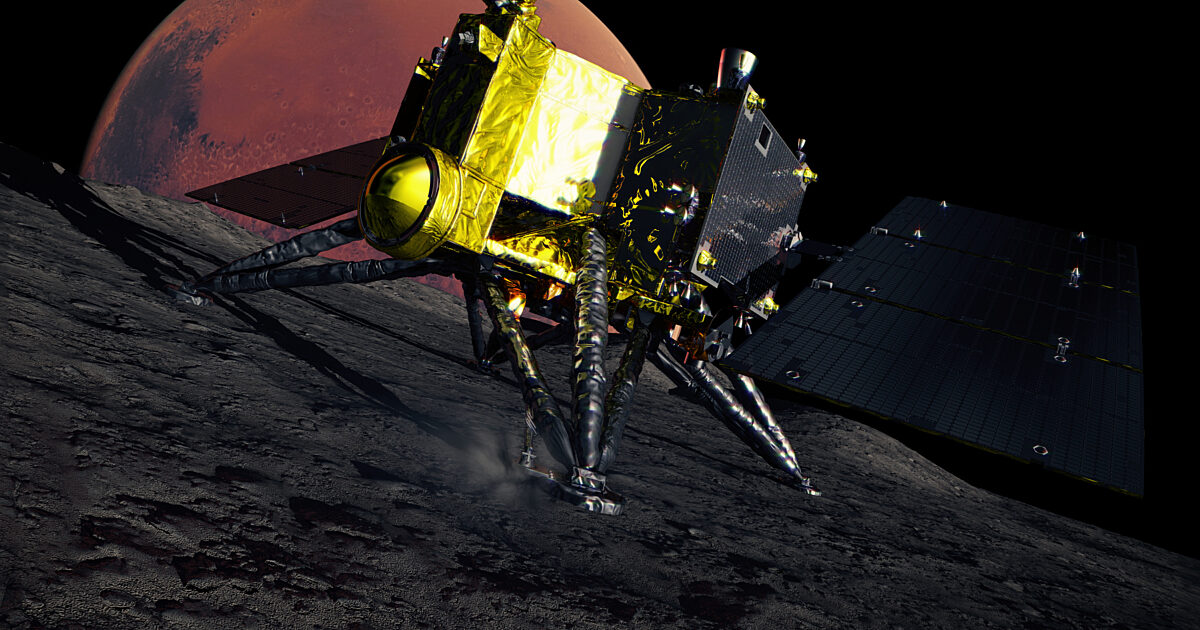
Image: The Planetary Society
The spacecraft aims to return the first samples from a Martian moon, using technology partly funded by public donations to test how Phobos formed.
Japan's space agency is preparing to launch the Martian Moons eXploration (MMX) mission as soon as next week, aiming to become the first mission to land on and return samples from a moon of Mars. The spacecraft will target Phobos, one of Mars' two small moons, in hopes of determining how it and its sibling moon Deimos formed.
Aboard MMX is an instrument called P-sampler, built on technology known as PlanetVac that was partly developed with support from Planetary Society members. Rather than scooping or drilling, PlanetVac uses blasts of nitrogen gas to stir up surface material and sweep it into a collection chamber, offering a lighter and potentially cheaper alternative to traditional sampling tools.
The technology's path to flight included two key boosts from the Planetary Society: funding a complete working prototype and lab testing years ago when resources were limited, and later supporting a test flight on a vertical-takeoff rocket to prove the system could survive real launch and landing conditions. That demonstration helped the technology earn a spot on a lunar lander mission that touched down on the Moon earlier this year, where it successfully gathered samples despite an uneven landing.
MMX carries multiple instruments beyond the sampler, including cameras, lidar, spectrometers and a dust monitor to study Phobos from orbit for about a year before attempting a landing. It will also deploy a four-wheeled rover built by French and German space agencies to examine the moon's surface up close, helping verify the spacecraft's remote observations.
After collecting samples using both the gas-based sampler and a separate coring device, and possibly repeating the process at a second landing site, MMX plans to leave the Martian system within the next few years, swinging past Deimos along the way. The mission would then return its samples to Earth, descending by parachute to a landing site in Australia.
The launch is scheduled for mid-October from Japan aboard an H3 rocket, with a backup window extending into early November if needed.
Sources
Mars moon mission set to launch with tech funded by Planetary Society onboard
Written in Everything Space’s own words by our news-desk model from the sources above, and checked against them in code: every number in this report appears in its sources, and no sentence is copied from them.