
News Desk · Everything Space
Expedition 1 docked at the ISS on Nov. 2, 2000, beginning 26 years of continuous human presence
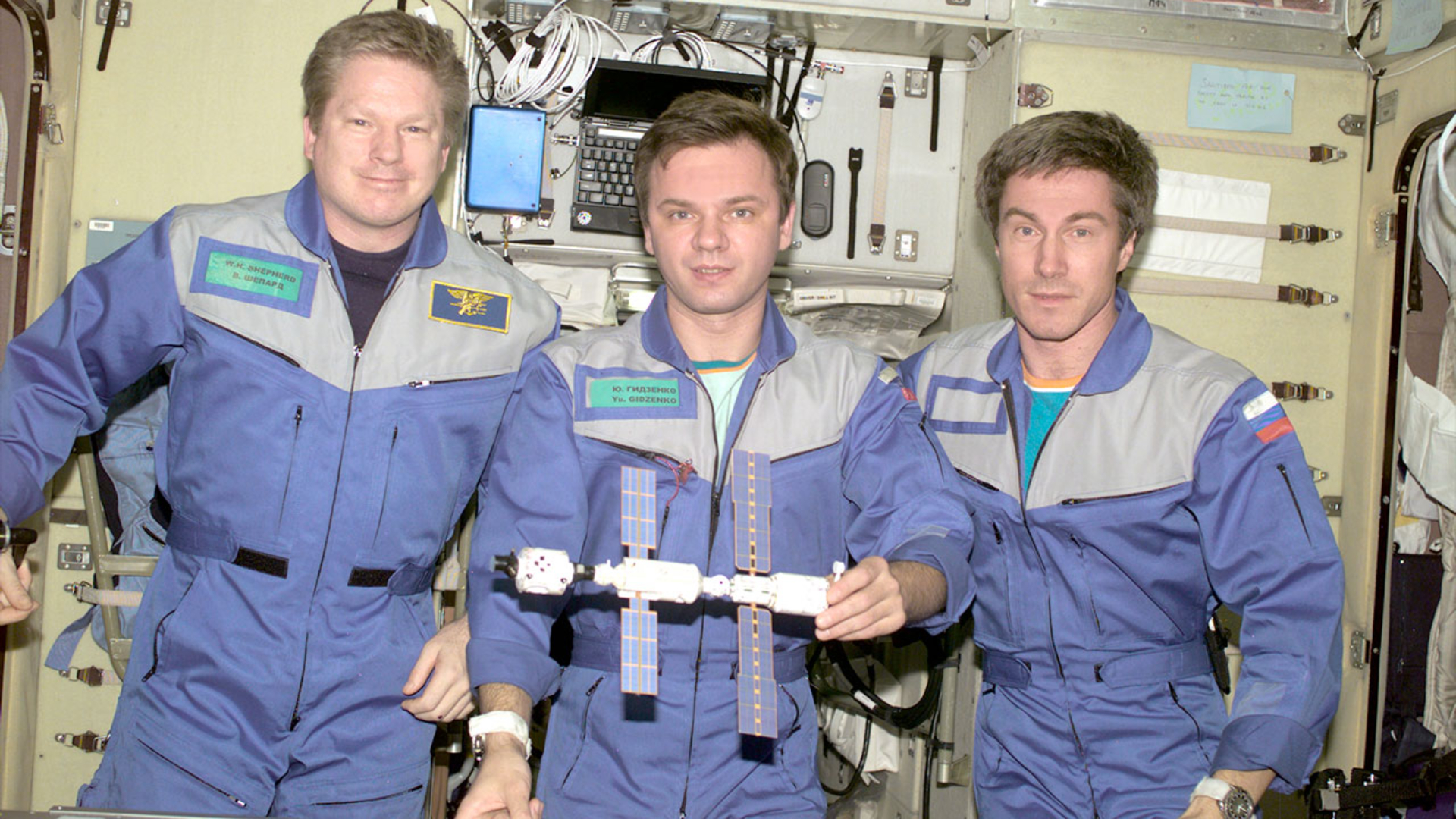
Image: Space.com
The arrival of the first long-term crew proved the station could sustain astronauts and set off an unbroken streak of human habitation in orbit.
On Nov. 2, 2000, the International Space Station received its first long-duration crew: NASA astronaut Bill Shepherd along with Russian cosmonauts Yuri Gidzenko and Sergei Krikalev. Known as Expedition 1, this mission marked the beginning of what has become an unbroken run of human habitation aboard the orbiting outpost.
Unlike the five earlier shuttle missions that had delivered station components and supplies over the course of roughly a week each, this crew arrived aboard a Russian Soyuz spacecraft and planned to remain in orbit for about four and a half months. Their flight marked the first time a Soyuz vehicle docked with the space station.
During their stay, the three men unpacked cargo, set up equipment, and installed the station's first solar arrays. They eventually departed aboard space shuttle Discovery, which also ferried up the next crew, Expedition 2, to continue the station's work.
That mission's legacy now spans 26 years of continuous astronaut presence in orbit, a streak that has held steady since Expedition 1 first proved the station could reliably host crews.
Although the ISS was not the first space station ever built, it has outlasted all predecessors by a wide margin. Hundreds of astronauts from multiple countries have lived and worked aboard it since that first crew's stay. Even as NASA has signaled that the station could eventually be retired, Expedition 1's accomplishments remain a foundational chapter in spaceflight history.
Sources
On this day in space! Nov. 2, 2000: Expedition 1 Arrives at the International Space Station
Written in Everything Space’s own words by our news-desk model from the sources above, and checked against them in code: every number in this report appears in its sources, and no sentence is copied from them.