
News Desk · Everything Space
ESA-JAXA's Ramses asteroid probe powers on its core module for the first time
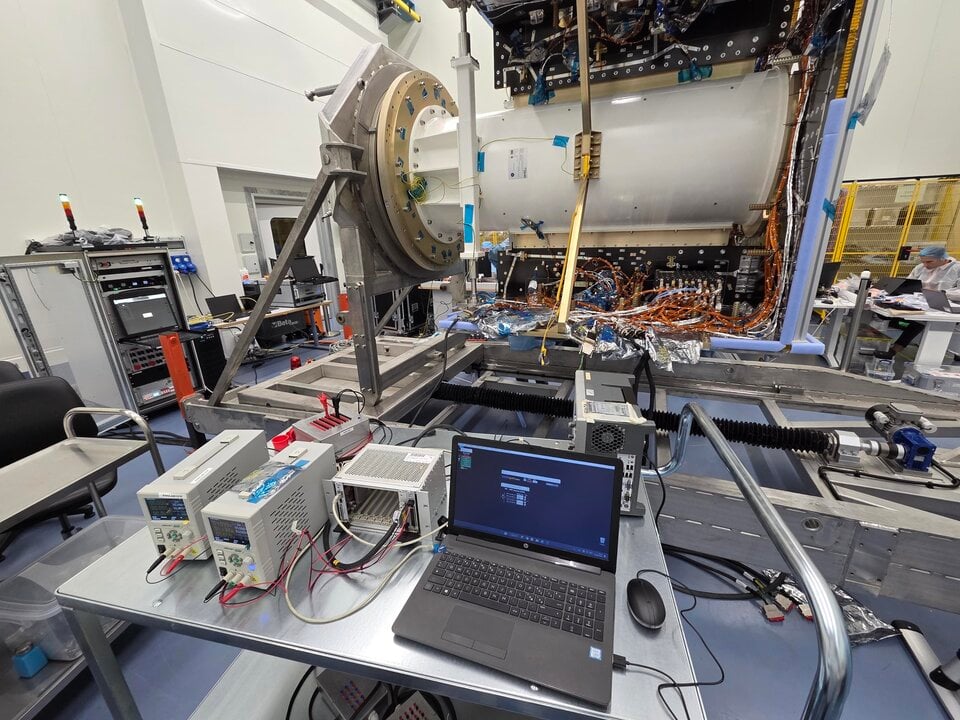
Image: Universe Today
The milestone marks progress toward a tightly scheduled mission to study asteroid Apophis during its rare 2029 close pass by Earth.
The core electronics module for the joint ESA-JAXA Ramses spacecraft has been switched on for the first time, according to the European Space Agency, marking an early but important checkpoint in the mission's compressed development schedule.
Ramses is designed to observe asteroid Apophis, a large space rock expected to pass within roughly 32,000 kilometers of Earth's surface in April 2029. That flyby distance is closer than many satellites orbit, offering scientists a rare chance to study a near-Earth asteroid up close without it posing an impact threat.
The mission has an unusually short build timeline. After preliminary contracts were signed in late 2024, the full construction agreement was only finalized this past February, leaving little more than three years to design, build, test and launch the spacecraft before Apophis arrives.
To meet that deadline, engineers split the spacecraft into two sections built in parallel. A propulsion module, containing the fuel system and structural framework, is under construction in Germany, while the core module—the spacecraft's electronic and power-distribution 'brain'—was assembled and tested in Italy.
The successful power-up of the core module indicates that its individual components, including its power distribution unit and onboard memory system, are functioning together as intended, even though such integration tests often reveal problems when previously separate systems are combined.
The two spacecraft halves are scheduled to be joined next year in the Netherlands, along with two companion CubeSats, before undergoing rigorous environmental testing meant to simulate the extreme conditions of spaceflight.
If all testing succeeds, Ramses is expected to launch on a Japanese rocket in early 2028, giving it time to reach position and observe Apophis during its historic close approach the following year.
Sources
ESA And JAXA's Planetary Defense Mission Powers On For The First Time
Written in Everything Space’s own words by our news-desk model from the sources above, and checked against them in code: every number in this report appears in its sources, and no sentence is copied from them.