
News Desk · Everything Space
Cosmologists refine methods to search for signs of a looped, finite universe
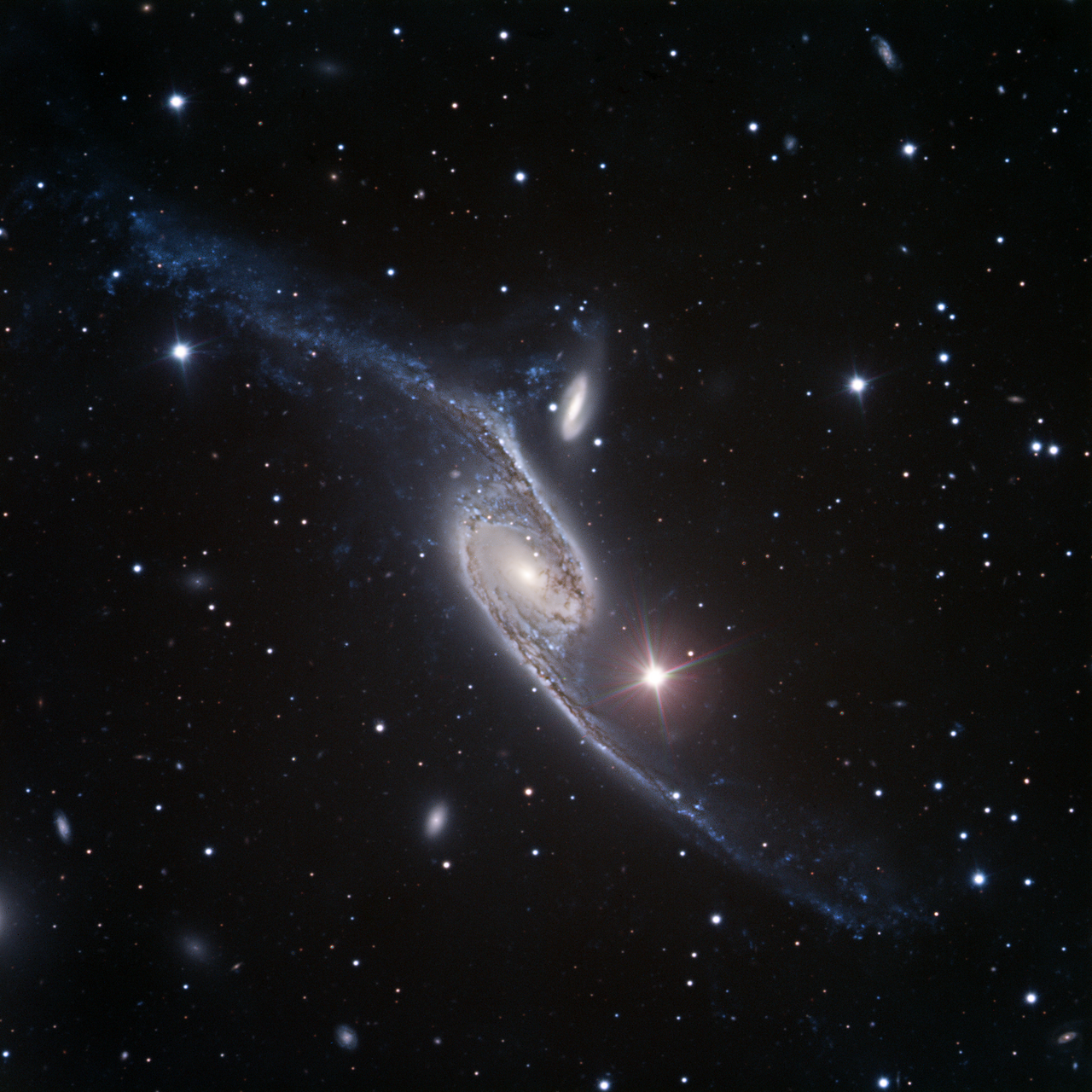
Image: Universe Today
A growing collaboration is testing whether patterns in the cosmic microwave background and galaxy distributions could reveal that space loops back on itself.
Researchers studying cosmic topology are working to determine whether the universe, rather than being infinite and flat as commonly assumed, might have a shape that loops back on itself over immense distances. If true, a spacecraft traveling far enough in one direction could theoretically return to its starting location in space, though not in time.
This idea hinges on the mathematical possibility of unshrinkable closed loops within the universe's geometry. If such loops exist and are small enough relative to the observable universe, they should leave detectable traces in the cosmic microwave background, the ancient light released roughly 380,000 years after the Big Bang, as well as in the large-scale arrangement of galaxies and matter.
Scientists have studied the cosmic microwave background since the 1960s, but only gained the sensitivity needed to search for topological signatures in the early 2000s, aided by data from missions like WMAP and later, more refined surveys. Since then, data quality has largely plateaued, prompting researchers to focus on refining theoretical models rather than waiting for entirely new observations.
A collaboration called COMPACT, made up of roughly twenty scientists internationally, has been working to formalize the mathematics behind possible universal topologies. Their approach includes analyzing whether distant regions of the sky that appear unrelated might actually be connected, potentially appearing as matching circular patterns in the cosmic microwave background, similar to loops that could exist on the surface of a torus-shaped universe.
Beyond the cosmic microwave background, researchers hope that building a detailed three-dimensional map of matter across the universe, including gas, galaxies, and galaxy clusters, could offer stronger evidence of any looping structure. However, if such repeating structures exist, they may be positioned too far apart for current or even future telescopes to observe both instances at once.
Whether this evidence can ever be found also depends on the fundamental scale of the universe itself. If the universe turns out to be far larger than the visible boundary marked by the cosmic microwave background, any topological signal may lie permanently beyond the reach of observation.
Researchers suggest that evidence supporting or ruling out these topological models could already be hidden within existing datasets, or might emerge from future efforts to map the distribution and motion of galaxies across the cosmos.
Sources
Astronomy’s Decades-Long Quest To Understand Cosmic Topology
Written in Everything Space’s own words by our news-desk model from the sources above, and checked against them in code: every number in this report appears in its sources, and no sentence is copied from them.