
News Desk · Everything Space
Beryllium signature shows a Sun-like star swallowed a rocky planet
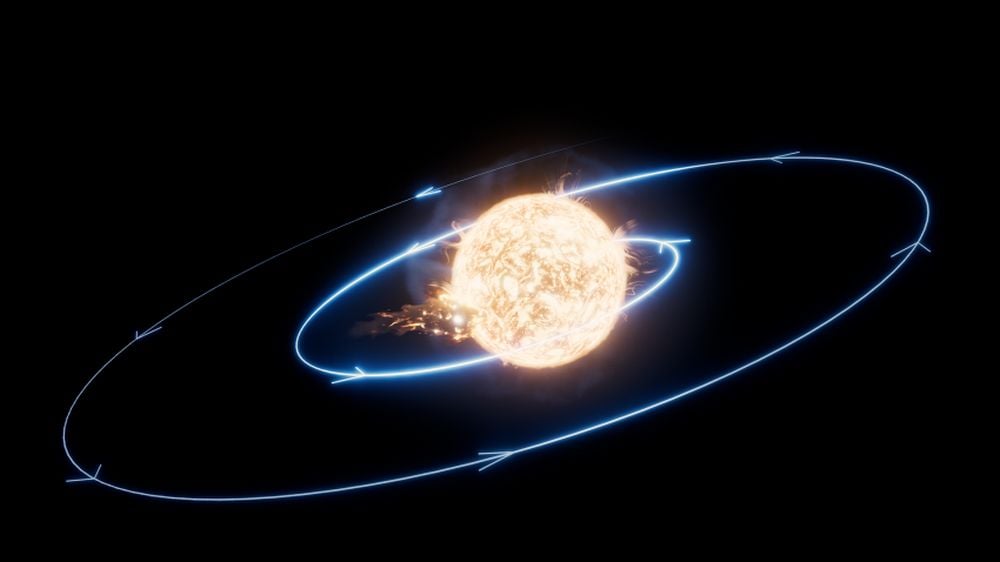
Image: Universe Today
A binary star study finds one twin absorbed roughly 11 Earth masses of rocky material, hinting that stable systems like our own may be uncommon.
Researchers studying a binary pair of Sun-like stars located about 180 light years away have found chemical evidence that one of the two engulfed a rocky planet in its past. The stars, HD 129171 and HD 129209, formed from the same cloud of gas and should share nearly identical compositions, yet they differ notably in the abundance of certain elements.
The team, led by doctoral student Anne Rathsman, used spectra gathered with the Very Large Telescope's UVES instrument to measure precise differences between the two stars. They found that HD 129171 carries an excess of refractory elements such as iron, magnesium, silicon, calcium and titanium, materials typically associated with rocky planetary bodies.
The key to confirming an engulfment scenario was beryllium, a rare element that cannot be produced by nuclear fusion inside stars. Because beryllium survives destruction more easily than lithium, which has previously been used as a possible engulfment marker but breaks down too readily to be reliable, its presence offers a longer-lasting chemical fingerprint. Modeling showed that the pattern of elemental differences between the two stars matches a scenario in which HD 129171 absorbed about 11 Earth masses of rocky material, whether from a single large planet or several smaller bodies.
The researchers say internal mixing in stars like these erases finer details, so it isn't possible to tell whether the consumed material came from one world or many. Still, the beryllium method itself is presented as a dependable diagnostic tool for identifying past planetary engulfment in other Sun-like stars.
Beyond the specific system, the findings feed into a broader question about how common stable planetary arrangements like our own solar system might be. Simulations already struggle to reproduce configurations where outer gas giants follow calm, circular orbits while inner rocky planets remain stable, and few exoplanetary systems with Jupiter-like orbits have been observed. The authors suggest that if planetary engulfment turns out to be widespread, many planetary systems may go through violent dynamical upheavals that could disrupt the long, stable conditions needed for life to develop.
Sources
Written in Everything Space’s own words by our news-desk model from the sources above, and checked against them in code: every number in this report appears in its sources, and no sentence is copied from them.