
News Desk · Everything Space
Astronomers trace 300-day gap between black hole's feeding flare and jet burp
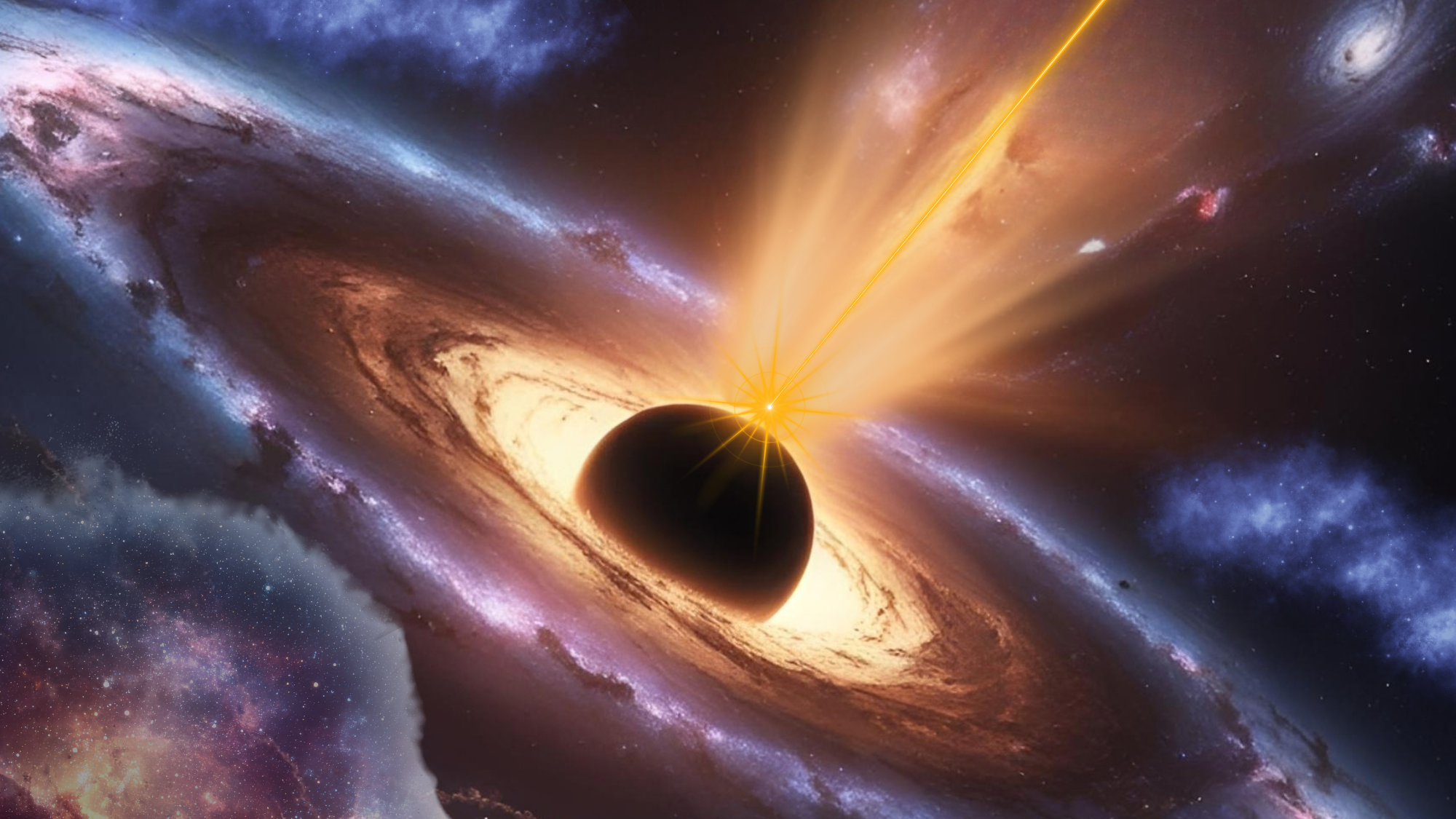
Image: Space.com
The delayed radio jet from NGC 1275's supermassive black hole offers rare evidence of how accretion feeds jet launches that shape galaxies.
Researchers combining X-ray data from NASA's Swift observatory with radio observations have tracked a supermassive black hole at the center of galaxy NGC 1275 as it flared brightly in X-rays and then, roughly 300 days later, produced a burst of radio emission from its jets.
NGC 1275 sits at the heart of the Perseus Cluster, a large grouping of galaxies, and hosts an actively feeding black hole surrounded by a glowing disk of infalling material. Some of that material is funneled into twin jets blasted from the black hole's poles, visible across the electromagnetic spectrum, especially in radio waves.
Using years of archival Swift data stretching back to 2007, the team built a model to subtract out light from the surrounding cluster, allowing them to isolate the black hole's own X-ray output over time. This let them spot a particularly intense X-ray flare in February 2023, when the galaxy's brightness briefly doubled during two short bursts.
The researchers ruled out a tidal disruption event, in which a black hole shreds a passing star, as the cause of the flare, concluding instead that it stemmed from a surge in the rate of matter falling into the black hole. By analyzing the size of the region emitting the radiation, they also estimated the black hole's mass at somewhere between 100 million and 1 billion times that of the sun.
Comparing the X-ray flare timing with existing radio observations, the team found tentative evidence of a roughly 300-day lag before the jet lit up in radio waves, a delay thought to reflect the time needed for ejected plasma to travel from the jet's base to the point where it collides with surrounding gas and dust.
The scientists caution that the finding is preliminary, since the X-ray coverage of the galaxy is sparse, and further X-ray and radio monitoring will be needed to confirm the relationship. Additional observations with other X-ray missions may also help determine whether a related emission feature represents an echo of the flare closer to the black hole itself.
The study has been accepted for publication in a peer-reviewed astrophysics journal, with a preliminary version already posted online.
Sources
Written in Everything Space’s own words by our news-desk model from the sources above, and checked against them in code: every number in this report appears in its sources, and no sentence is copied from them.