
SpacePolicyOnline.com · Fri, 13 Nov 2026 04:55:42 GMT
Senate Appropriations CJS Subcommittee Proposes $24.9 Billion for NASA in FY2027
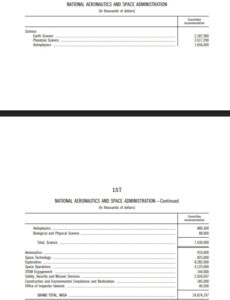
The Senate Appropriations Committee released five more FY2027 bills this evening, including the Commerce-Justice-Science bill that funds NASA. The CJS subcommittee is proposing $24.874 billion for NASA, slightly more than the $24.438 billion approved by Congress for FY2026. By contrast, the Trump Administration requested $18.8 billion in FY2027.
NASA implemented a major reorganization earlier this year, merging and/or rearranging the mission directorates and budget structure. The subcommittee’s report explains that the changes happened too late and lacked sufficient detail for them to be incorporated in this bill, however.
The text , explanatory statement , and a summary are posted on the committee’s website. The bill also funds the Department of Commerce (including NOAA), the Department of Justice, and the National Science Foundation.
Total funding for NASA, and for NASA’s science and exploration programs, are shown below.
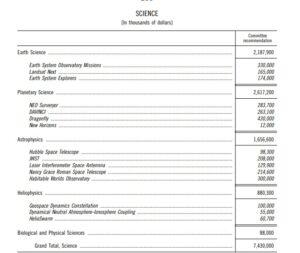
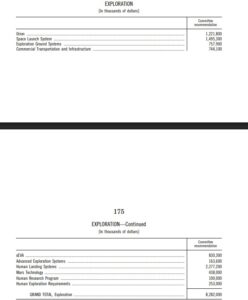
The committee released two other bills on Tuesday. A schedule for the full committee to meet and consider the subcommittee recommendations hasn’t been announced. None of the 12 FY2027 appropriations have cleared Congress yet. The government is operating under a Continuing Resolution that expires on December 11.
The House Appropriations Committee approved its version of the CJS bill on May 13, but it has not passed the House yet. Like the Senate, it rejected the deep cuts proposed by the Administration, recommending $24.4 billion. The bill cleared the committee on a party-line vote because Democrats objected to provisions in the Commerce and Justice sections of the bill. During subcommittee markup, Democrats also opposed the level of funding for NASA’s science programs — $6 billion. While $2 billion more than the $3.9 billion requested, it is $1.3 billion less than FY2026.
A few highlights from the Senate committee’s report ( not a comprehensive list ):
The Committee rejects the mission terminations proposed in the fiscal year 2027 budget request for Earth Science, Planetary Science, Astrophysics, and Heliophysics. The Committee is concerned by the plan to end 53 missions across Science, which was again driven by budgetary pressure rather than scientific value. … Further, the Committee affirms the importance of NASA upholding its commitments to our international partners and expects future budget requests to sustain funding to fulfill these commitments, including for missions such as Laser Interferometer Space Antenna and Rosalind Franklin ExoMars Rover.
Space Technology: $825 million
The Committee provides $8,282,000,000 for Exploration, which is $499,000,000 above the fiscal year 2026 enacted level. The Committee believes the Nation deserves a safe, robust, and ambitious human spaceflight program that establishes a sustainable American presence. … The Committee encourages NASA to reduce technical and schedule risk, improve affordability, and increase mission cadence by leveraging fixed-price partnerships and commercial service approaches wherever appropriate. These efforts shall be executed within a fully integrated exploration architecture, including transportation, habitation, mobility, logistics, and communications, which strengthens the domestic industrial base, preserves critical workforce skills, and advances a sustainable pathway to Mars. … While acknowledging remaining challenges, the Committee expects NASA to maintain stable requirements, realistic schedules, and transparent cost and risk assessments.
Space Operations: $4.125 billion
This article has been updated.
Reported by SpacePolicyOnline.com. Reproduced unedited by Everything Space. View the original →
What do you make of it?
Nobody has weighed in on this story yet.
Related in the Atlas