
SpaceDaily · Thu, 05 Nov 2026 02:06:07 GMT
Two giant black holes at the heart of one galaxy may circle each other every 121 to 146 days and could merge in as little as 100 years
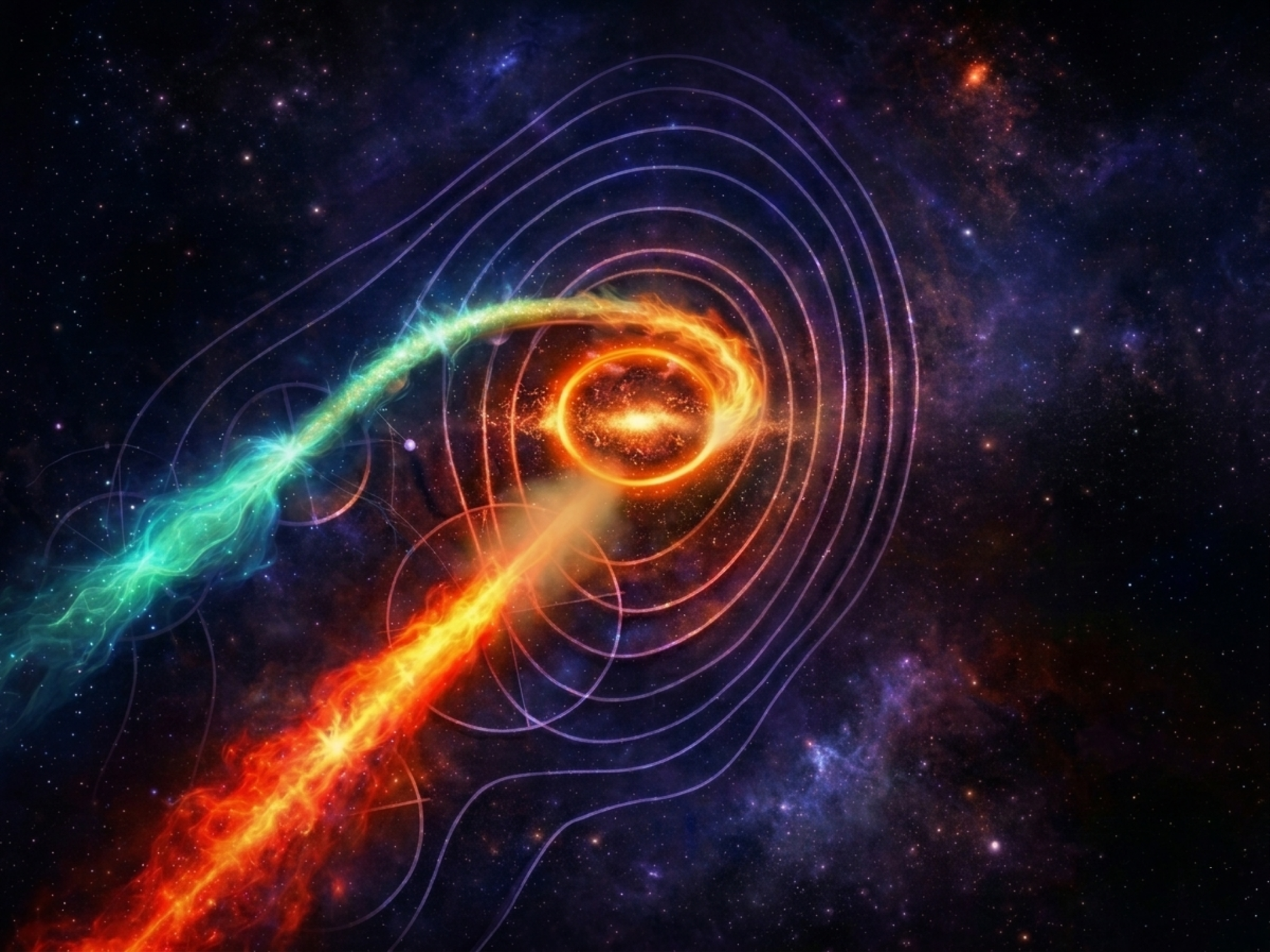
Two supermassive black holes may be locked in orbit at the heart of the galaxy Markarian 501, going round each other every 121 to 146 days, and on one estimate they could merge within about a century. The claim comes from a team led by Silke Britzen of the Max Planck Institute for Radio Astronomy in Bonn, published in Monthly Notices of the Royal Astronomical Society .
The second black hole has never been seen. What the astronomers saw is a second jet of radio emission, curling around the galaxy’s core in a way one black hole struggles to explain. How much weight that jet can bear is the real story.
A jet that will not sit still
Markarian 501 is a blazar in Hercules, about 460 million light-years away, whose jet points almost straight at Earth. Astronomers have argued for decades over why that jet bends so sharply between its inner and outer reaches, and a hidden second black hole has long been one suggested answer.
Britzen’s team went back to 83 radio images of the core taken at 43 GHz with the Very Long Baseline Array between September 2011 and July 2023, drawn from Boston University’s public blazar monitoring archive. Alongside the familiar jet, they traced a second one. It appears to start on the far side of the core and loop anticlockwise around it. In two images ten days apart in 2023, it swung south and merged into the main jet, a pattern the team says recurs across the data.
Two slower rhythms sit on top. The whole jet system drifts clockwise, and the galaxy’s total radio brightness rises and falls on a cycle of about 7.4 years. On 24 June 2022, the second jet’s knots lined up in an almost circular arc around the core, which the team reads as a partial Einstein ring: light bent by the gravity of a black hole in front.
Some reports say the team analysed 23 years of data. That figure belongs to an earlier study of lower-frequency images from 1995 to 2018, which showed the jet’s features barely moving. The new detection rests on the 12-year, higher-resolution set.
Four months, give or take
The widely quoted 121-day orbit is the least certain number in the paper. It comes from a faint repeating signal in the core’s brightness, which the authors describe as not well constrained. Timing how often the second jet returns to the same shape gives a different answer: 146 days, give or take 22.
Asked which figure readers should take, Britzen pointed to the gaps in the record. “In the ideal case, the VLBA data would have been observed more frequently,” she told Space Daily by email. “Gravitational lensing is great to detect, but it complicates the determination of the orbit. I consider a value between 121 and 146 days as most realistic.”
The sampling problem cuts both ways. The paper notes that the uneven spacing of the observations could have hidden an even faster motion.
A century, if the numbers hold
Assuming the two black holes weigh the same, the team puts each at between 100 million and a billion Suns, separated by roughly 250 to 540 times the distance from Earth to the Sun. Taking a combined mass of 700 million Suns from earlier work and the 146-day timing, corrected for the galaxy’s redshift, the orbit comes out at about 469 Earth–Sun distances.
A pair that close loses orbital energy to gravitational waves. The authors calculate the binary should last at least 250 more orbits, which is where the figure of about a century comes from. That estimate assumes a nearly circular orbit. Yet the team’s own explanation for the 7-year rhythm, a slow wobble of the orbital plane, works only if the orbit is highly elongated, and they say that would need a more careful lifetime estimate.
No telescope will watch the gap close. At their widest, the two black holes would sit 3.6 microarcseconds apart on the sky. The Event Horizon Telescope resolves about 20, and the proposed Black Hole Explorer mission is expected to reach about 6.
Reasons for caution
The Einstein ring is the most vivid part of the story, and the paper itself is cautious about it. Its own calculation finds that for the front black hole to bend the second black hole’s light into a ring of that size, the two would need to be 10 to 100 parsecs apart, around ten thousand times the orbit the team proposes. The authors offer an alternative: the ring is light from the extended second jet, not from the black hole that launches it.
Britzen still sees the ring as strong support. “Detecting a ring supports the binary case and would be expected in a binary case,” she said. She called it a very important confirmation of the scenario her team proposes.
The team also tested explanations that need only one black hole, including ripples along the jet’s edge, shifts in where the core appears at different frequencies, and shock waves travelling down the jet. In their view, none accounts for everything they see. They also note a practical limit: in 17 of the 83 images, something other than the core was the brightest spot, and none of the observations were tied to a fixed reference point on the sky, so lining up the images relied on careful judgement.
Markarian 501 has been read for hidden companions before, with periods of 23, 72, 332 and 630 days proposed from different data. A 2024 study by Gustavo Magallanes-Guijón and Sergio Mendoza at the National Autonomous University of Mexico found a repeating signal of about 224 days from radio to gamma rays. They modelled it as a far lighter companion, no more than about 100,000 Suns, whose gravitational waves would suit the planned LISA space observatory, not pulsar timing. Both teams invoke a second black hole; they disagree on almost everything about it.
Across the field, apparent cycles in the flickering of black holes have a mixed record. Random variability can mimic a period over a few repeats, and the best-known candidates, such as the quasar PG 1302-102, have drawn published challenges.
How it could be settled
If the pair is real, it should hum in gravitational waves at about 8 × 10 −8 hertz, inside the band that pulsar timing arrays listen to. Those arrays track dozens of spinning neutron stars as cosmic clocks, and in 2023 they found evidence of a background of such waves, which binaries like this are the favoured explanation for. The paper frames a detection of Markarian 501 itself as a job for the Square Kilometre Array era: more than 20 well-timed pulsars watched for more than a decade.
The payoff would be unusual. Co-author Héctor Olivares, of the University of Aveiro, said in the institute’s press release that a rising wave frequency would offer “a rare chance to watch a supermassive black hole merger unfold”. A nearer test is simpler: radio images taken often enough to pin the orbit down, and to see whether it is shrinking.
In August, Space Daily reported three feeding black holes in the young galaxy J0148-4214 , where the central pair sit 620 light-years apart and will take some 700 million years to meet. Markarian 501, if Britzen’s team is right, sits at the other end of that story: close to home, a few hundred Earth–Sun distances apart, in the last stretch, where gravitational waves rather than surrounding stars do the work.
Jenny Olalo
Contributing writer at Space Daily.
Reported by SpaceDaily. Reproduced unedited by Everything Space. View the original →
What do you make of it?
Nobody has weighed in on this story yet.