
ESA · Fri, 09 Oct 2026 10:00:00 GMT
Farewell to the Fluid Science Laboratory after 18 years in orbit

On 9 October, astronauts on the International Space Station begin supporting the final decommissioning of ESA's Fluid Science Laboratory (FSL), one of the longest-serving scientific facilities inside Europe's Columbus laboratory.
Since its launch with Columbus in February 2008, FSL has helped scientists investigate how fluids, foams, emulsions and granular materials behave in microgravity. During more than 18 years in orbit, the facility completed over 101 000 orbits around Earth, supported 18 scientific experiments and accumulated above 42 000 hours of operations, making it one of the longest-running research facilities in ESA's orbital laboratory.
Originally designed to operate for 10 years, FSL remained productive for nearly twice as long, thanks to the dedication of the international teams who operated and maintained it.
A laboratory built for microgravity science

Many physical processes that seem ordinary on Earth behave very differently in space. Without gravity-driven effects such as buoyancy and sedimentation, scientists can observe the fundamental physics governing the behaviour of liquids, gases and soft matter. To take advantage of these unique conditions, FSL provided a dedicated research environment for experiments investigating boiling dynamics, foams, emulsions, gels and granular materials.
Researchers used the facility for investigations including: GEOFLOW , which modelled processes similar to those occurring deep inside Earth; RUBI , which studied combustion and heat transfer; FOAM-C , which explored the behaviour of liquid foams; COMPGRAN , which examined granular materials; and more recently PASTA , investigating particle transport and aggregation.
Together, these experiments reveal how everyday materials such as foams, powders and emulsions behave in space, providing insights relevant to industries ranging from manufacturing to food production.
The final science campaign
FSL's final science activities concluded in July 2026, bringing more than 18 years of research operations to a close. One of the laboratory's final research programmes was PASTA-3, short for PArticle STAbilised emulsions.

Using FSL's Soft Matter Dynamics experiment container, researchers studied how emulsions - mixtures of liquids that do not naturally mix, such as oil and water - form and evolve in microgravity. By removing the effects of gravity, scientists can better understand the mechanisms that influence emulsion stability and behaviour.
The final PASTA-3 samples arrived at the International Space Station aboard the Cygnus NG-23 spacecraft in September 2025. Following extensive preparation and testing on the ground, ESA astronaut Sophie Adenot helped complete one of the laboratory's last crew-assisted science activities during her εpsilon mission earlier this year.
A European effort in orbit and on the ground
The story of FSL began shortly after Columbus arrived at the International Space Station in 2008.
French ESA astronaut Léopold Eyharts carried out the facility's initial activation and commissioning, beginning a scientific journey that would span generations of astronauts, researchers and operations teams across Europe.
Throughout its lifetime, FSL supported a broad programme of research made possible by close cooperation between crews in orbit and specialists on the ground. Astronauts installed experiments, exchanged samples and carried out maintenance, while scientists, engineers and operators coordinated activities from Earth and analysed the results.
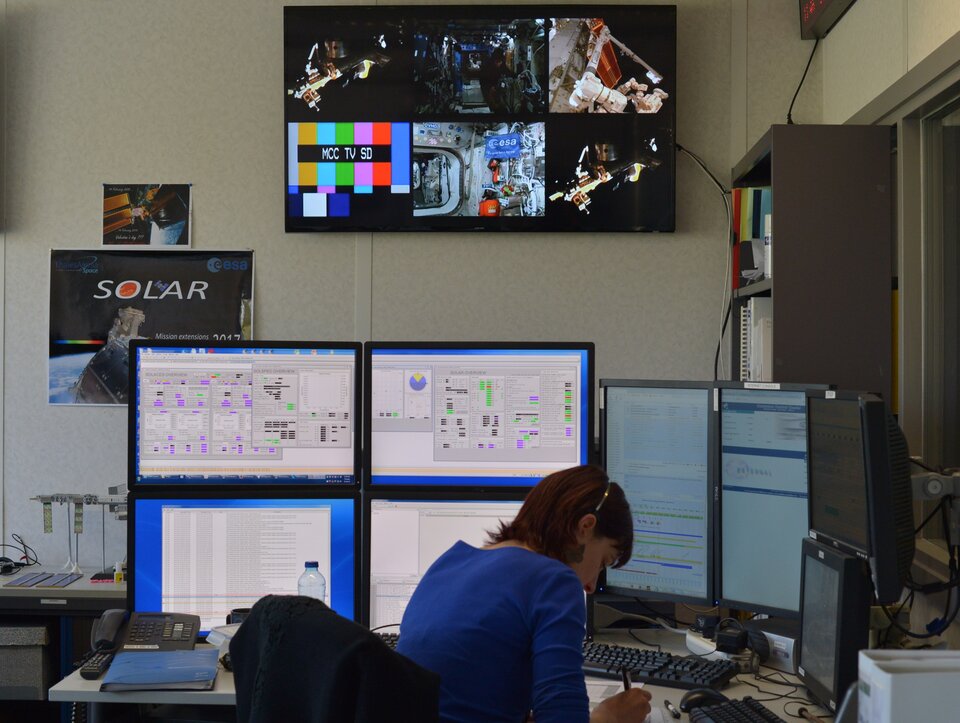
For more than a decade, the Belgian User Support and Operations Centre (B.USOC) coordinated the facility's day-to-day science operations, preparing experiments, supporting astronauts during crew activities, monitoring performance and ensuring scientific data reached researchers for analysis.
Over the years, countless specialists helped keep the facility running well beyond its planned lifetime. When the final science operations concluded earlier this year, the B.USOC team described the moment as "bittersweet", reflecting on nearly two decades of scientific achievements and collaboration.
A lasting legacy
Although the hardware is now entering its final phase, FSL's scientific legacy will continue.
Over the coming months, astronauts will prepare the facility to be safe for disposal aboard a future cargo spacecraft, after which the crew will remove it from Columbus and transfer it to its assigned vehicle, for its final trip and destructive reentry into the Earth atmosphere. As one chapter closes, the retirement of FSL will also free up valuable space inside the European laboratory for future research hardware and scientific investigations, with the ESA X-Ray Facility (XRF) being the first in the line to take the vacant spot, to further improve humanity understanding in the field of materials science.
The knowledge generated through nearly two decades of experiments, together with the expertise developed by the teams who designed, operated and used FSL, will continue to support future research in low Earth orbit and beyond.
As astronauts begin dismantling a laboratory that has been part of Columbus since the earliest days of European operations on the International Space Station, the Fluid Science Laboratory leaves behind a remarkable legacy of discovery, international cooperation and scientific excellence.

Thank you for liking
You have already liked this page, you can only like it once!
Published by the European Space Agency. View the original →
What do you make of it?
Nobody has weighed in on this story yet.
Related in the Atlas