
● Launch Successful
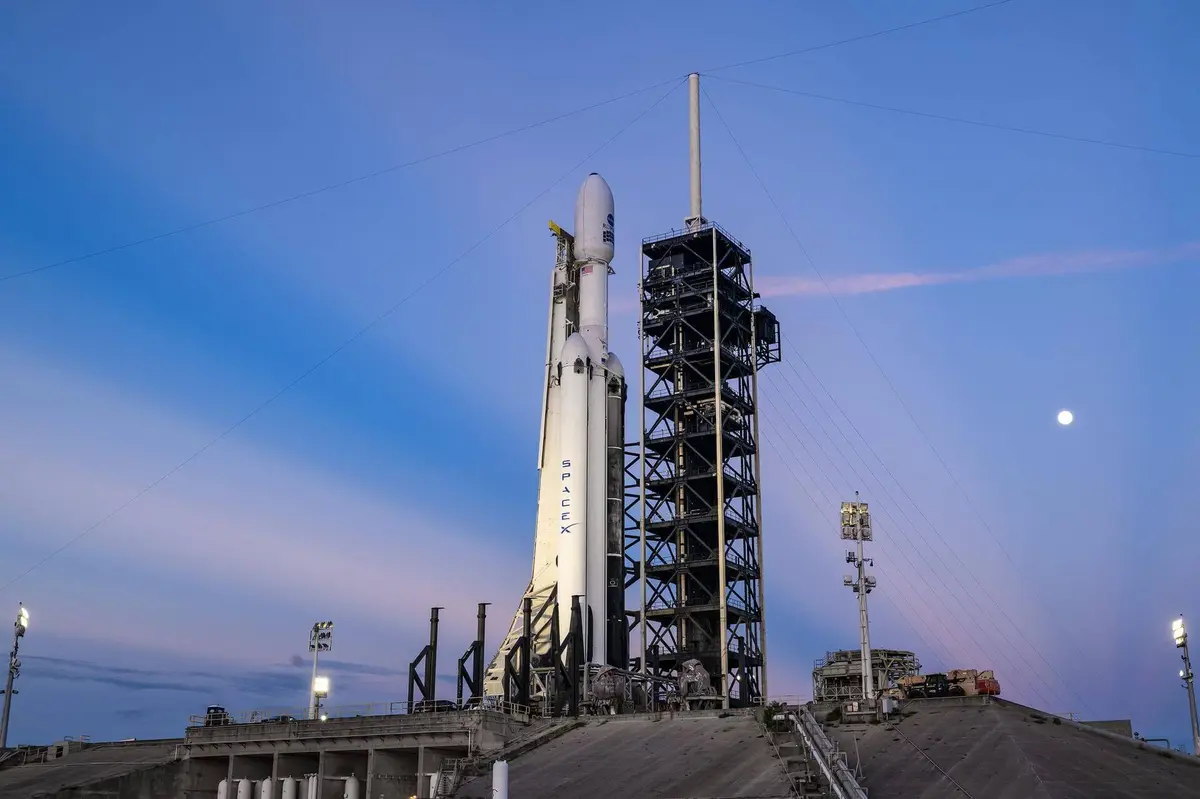
Falcon Heavy | Nancy Grace Roman Space Telescope
SpaceX · Launch Complex 39A · Kennedy Space Center, FL, USA
- SpaceX's 738th launch
- 223rd consecutive success
- 224th flight from Launch Complex 39A
- 1st flight of booster B1105
Watch
Broadcast links from Launch Library 2. The player is YouTube’s privacy-enhanced embed, which sets nothing until you press play. Some broadcasters switch embedding off for their own streams — if the player will not start, the link above opens it on YouTube.
Theater mode — webcast, countdown, flight plan, nothing else →
Flight Plan
- T-53:00GO for Prop Load
- T-50:00Stage 1 Propellant Load
- T-45:00Stage 1 LOX Load
- T-35:00Stage 2 Propellant Load
- T-18:30Stage 2 LOX Load
- T-7:00Engine Chill
- T-0:59Startup
- T-0:45GO for Launch
- T-0:20Tank Press
- T-0:06Ignition
- T+0:00Liftoff
- T+1:08Max-Q
- T+2:24SBECO
- T+2:27Boosters Separation
- T+2:32Boosters Flip
- T+2:43Boosters Boostback Burn Startup
- T+3:48Boosters Boostback Burn Shutdown
- T+3:51MECO
- T+3:54Stage 2 Separation
- T+4:00SES-1
- T+4:15Fairing Separation
- T+6:19Boosters Entry Burn Startup
- T+6:29Boosters Entry Burn Shutdown
- T+7:23Boosters Landing Burn
- T+7:40Boosters Landing
- T+8:28SECO-1
- T+24:33SES-2
- T+26:32SECO-2
- T+31:31Payload Separation
Planned times, published by the launch provider and carried by Launch Library 2 — not measurements. No public feed streams a rocket’s altitude or velocity during ascent, so this site does not show any. Times can move, and a hold moves everything after it.
The Mission
The Nancy Grace Roman Space Telescope is a NASA infrared space telescope with a 2.4 m (7.9 ft) wide field of view primary mirror and two scientific instruments. The Wide-Field Instrument (WFI) is a 300.8-megapixel multi-band visible and near-infrared camera, providing a sharpness of images comparable to that achieved by the Hubble Space Telescope over a 0.28 square degree field of view, 100 times larger than imaging cameras on the Hubble. The Coronagraphic Instrument (CGI) is a high-contrast, small field of view camera and spectrometer covering visible and near-infrared wavelengths using novel starlight-suppression technology. Roman objectives include a search for extra-solar planets using gravitational microlensing, and probing the expansion history of the Universe and the growth of cosmic structure, with the goal of measuring the effects of dark energy, the consistency of general relativity, and the curvature of spacetime.
| Liftoff (NET) | Sun, 30 Aug 2026 11:26:04 UTC |
|---|---|
| Launch window | 11:25:49 UTC – 11:26:19 UTC |
| Target orbit | Sun-Earth L2 |
| Status | Launch Successful |
Launch Library 2 · fetched Thu, 15 Oct 2026 00:07:36 GMT
Related in the Atlas